JW Therapeutics sets relma-cel's China insurance price at RMB 288,600, testing a 65% cost-cut target
JW Therapeutics (HKEX: 02126) disclosed an NRDL price of RMB 288,600 ($39,900) for CD19 CAR-T relma-cel from Jan 1, 2027, a 77.6% cut that relies on a >65% unit COGS drop pending NMPA vector approval.
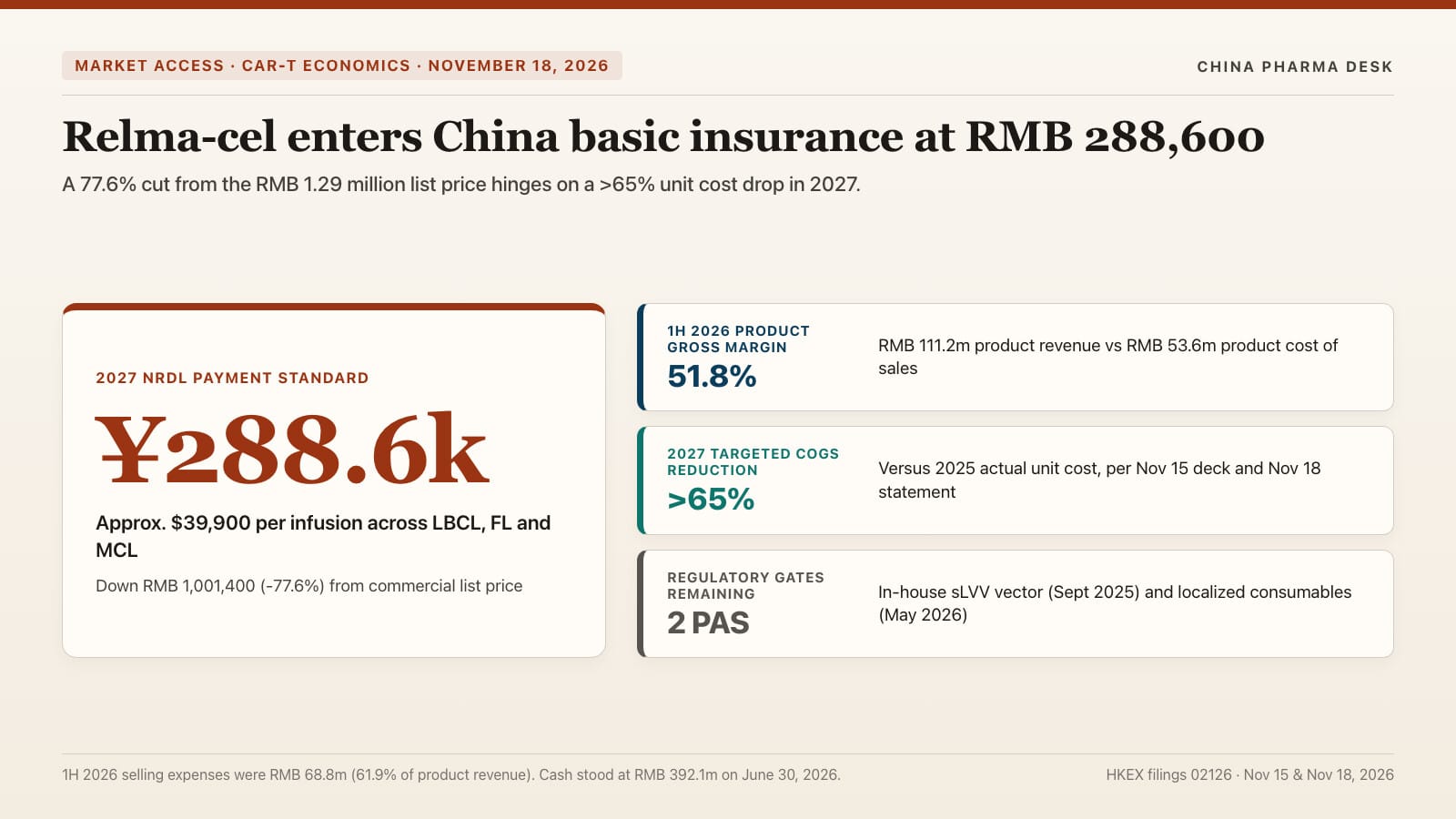
JW (Cayman) Therapeutics Co. Ltd (HKEX: 02126) disclosed in a November 15, 2026 Hong Kong Stock Exchange inside-information filing and investor presentation—followed by an official cost-clarification statement on November 18—that its autologous anti-CD19 CAR-T therapy relmacabtagene autoleucel (relma-cel, marketed in China as Carteyva or Beinuoda) will enter the 2026 National Reimbursement Drug List (NRDL) on January 1, 2027 at a payment standard of RMB 288,600 (approx. $39,900). That price cuts 77.6% (RMB 1,001,400) off relma-cel’s RMB 1.29 million (approx. $178,400) commercial list price across all three approved lymphoma indications. To defend per-patient profitability at under $40,000, management stated on November 15 and November 18 that unit production costs will fall by more than 65% from 2025 levels starting in 2027—a reduction that still depends on National Medical Products Administration (NMPA) approval of two post-approval manufacturing supplements (PAS).
When the National Healthcare Security Administration (NHSA) published Notice No. 29 of 2026 on November 14—making relma-cel the first CAR-T therapy to cross from China’s 2025 Commercial Health Insurance Innovative Drug List into basic national insurance, as analyzed in our initial NRDL CAR-T transition report and 2026 dual-list bridge analysis—the negotiated payment standard was not printed in the public catalogue table. JW Therapeutics’ November 15 filings put the exact figure on the record: RMB 288,600 per infusion, covering adult patients with relapsed or refractory large B-cell lymphoma (r/r LBCL), follicular lymphoma (r/r FL), and mantle cell lymphoma (r/r MCL) after two or more lines of systemic therapy.
What the audited 2025 and 1H 2026 financial statements show
The November 18 clarification was prompted by domestic industry calculations questioning how an autologous cell therapy can generate positive margins at RMB 288,600 when historical manufacturing and commercial costs exceeded that figure. Cross-checking JW Therapeutics’ audited 2025 annual results (filed March 26, 2026) and 2026 interim report (for the six months ended June 30, 2026) establishes the baseline numbers:
| Metric (IFRS, RMB millions unless noted) | FY 2024 (Audited) | FY 2025 (Audited) | 1H 2025 (Unaudited) | 1H 2026 (Unaudited) |
|---|---|---|---|---|
| Total revenue | 158.2 | 283.7 | 106.3 | 111.4 |
— Carteyva (relma-cel) product revenue |
158.2 | 219.0 | 81.2 | 111.2 |
— sLVV non-exclusive license revenue (BMS/Juno) |
— | 64.5 | 25.1 | — |
Carteyva product cost of sales |
(80.9) | (107.5) | (39.7) | (53.6) |
Carteyva product gross profit |
77.3 | 111.5 | 41.5 | 57.6 |
Carteyva product gross margin (%) |
48.9% | 50.9% | 51.1% | 51.8% |
| Selling expenses | (140.4) | (154.3) | (58.5) | (68.8) |
| — Selling expenses as % of product revenue | 88.7% | 70.5% | 72.0% | 61.9% |
| R&D expenses | (283.0) | (188.4) | (92.0) | (49.8) |
| Net loss for the period | (590.6) | (555.3) | (267.3) | (50.4) |
| Cash and bank balances (period end) | 613.6 | 503.1 | — | 392.1 |
In its November 15 filing, JW Therapeutics reported that more than 1,200 patients had been treated with relma-cel across over 200 certified hospitals through October 31, 2026 (including clinical trial and commercial infusions), with a >99% first-pass commercial manufacturing success rate and 100% delivery rate.
Even without an exact disclosed commercial infusion count for 2025 alone, the income statement ratios define the cost hurdle:
- Historical unit manufacturing cost vs. the new RMB 288,600 price: In 2025 and the first half of 2026, when
relma-celcarried a RMB 1.29 million retail list price (roughly RMB 1.14 million net of 13% VAT, or RMB 1.25 million under China’s 3% simplified VAT regime for biological products, before distributor margins), product cost of sales consumed 49.1% of product revenue in 2025 and 48.2% in 1H 2026. That places historical per-patient cost of goods sold (COGS)—which the interim report defines as raw materials, manufacturing overhead, depreciation and amortization, and direct labor—at roughly RMB 480,000 to RMB 550,000 per commercial infusion, nearly double the new RMB 288,600 gross NRDL payment standard. - What a >65% unit COGS reduction leaves for commercial overhead: In its November 18 statement, JW Therapeutics countered that comparing historical production costs directly against the 2027 NRDL price ignores three cost-reduction levers that management expects will lower unit production costs by more than 65% in 2027 versus actual 2025 levels: (i) replacing imported viral vectors with in-house suspension lentiviral vectors (
sLVV), (ii) substituting domestic equivalents for imported raw materials and consumables, and (iii) fixed-cost dilution from post-NRDL volume growth and modular cleanroom automation (which management says cuts staffing needs by 50%). Cutting a ~RMB 500,000 historical unit cost by 65% brings 2027 unit COGS down to roughly RMB 175,000 per infusion. Against an RMB 288,600 gross payment standard (RMB 255,400 net of 13% VAT, or RMB 280,200 net of 3% VAT), that leaves roughly RMB 80,000 to RMB 105,000 in gross profit per patient. - The selling-expense bottleneck: In 1H 2026, JW Therapeutics spent RMB 68.8 million on selling expenses to generate RMB 111.2 million in product revenue (61.9% of product sales, or more than RMB 600,000 per commercial patient). For a gross profit of ~RMB 80,000–105,000 per infusion to cover commercial costs and contribute toward R&D and G&A, per-patient selling expenses must fall by more than 80% as basic-insurance reimbursement replaces high-touch self-pay and municipal Huiminbao patient-finding.
Two pending NMPA post-approval supplements (PAS) gate the cost drop—and a HK$160 million placement
Crucially, two of the three pillars behind the >65% COGS reduction are chemistry, manufacturing and controls (CMC) changes that require prior regulatory sign-off before commercial batches can be released:
- In-house suspension lentiviral vector (
sLVV) PAS (submitted September 2025): JW Therapeutics has already validated itssLVVprocess externally—licensing it non-exclusively to Bristol Myers Squibb (NYSE: BMY) on April 18, 2025 (recognizing RMB 64.5 million in 2025 license revenue) and granting an option to Regeneron Pharmaceuticals (NASDAQ: REGN) on October 30, 2025 under an up-to-$50 million MAGE-A4 and manufacturing collaboration. ForCarteyvaitself, the company completed a CDE-required clinical comparability study and submitted the post-approval supplemental application (PAS) to the NMPA in September 2025. As of the November 18, 2026 clarification, thatsLVVsupplement remains under regulatory review. Moreover, per JW Therapeutics’ November 15, 2026 placement supplemental announcement, obtaining NMPA approval for the in-house lentiviral vector PAS is an explicit condition precedent (Condition(iv)) to closing the company’s HK$160 million (approx. $20.6 million) new-share placement, tracked in our Nov 9–15 Weekly Ledger. - Localized equipment and critical consumables PAS (submitted May 2026): According to the 2026 interim report, the supplemental applications to switch key manufacturing equipment and critical consumables to domestic suppliers were submitted to and accepted by the CDE in May 2026 and are likewise awaiting final approval.
Cash runway, competitive price anchors, and JW’s own in vivo CAR-T pivot
As of June 30, 2026, JW Therapeutics held RMB 392.1 million (approx. $54.2 million) in cash and bank balances against RMB 315.1 million in current liabilities (including RMB 180.7 million in short-term borrowings and RMB 227.7 million in total unsecured bank borrowings), after burning RMB 111.0 million in net cash during the first half of 2026. To conserve cash for relma-cel expansion and next-generation assets, the company signed an agreement on November 9, 2026 to divest Greater China and ASEAN rights to its solid-tumor AFP and GPC3 T-cell therapies (JWATM204/214) to Eureka Therapeutics for $10 million upfront, 10% of near-term downstream sublicensing proceeds, and up to $100 million in sales milestones.
In its November 15 investor presentation, JW Therapeutics estimated China’s current 3L+ LBCL CAR-T treatment penetration at 3.5% (from a 2025 market survey), compared with 43% in the United States and 52% in France (extrapolated by the company from 2023 and 2026 literature), sizing the annual incidence across relma-cel’s three NRDL-covered lymphoma indications at roughly 11,000 patients.
At the same time, slides 8 through 14 of the November 15 deck show how JW Therapeutics is preparing for the post-autologous era:
JWCAR239(dual-targetedCD19/CD20, dual-armoreddnTGFβRII+dnFAS-CD2autologous CAR-T): Designed for the ~50% of patients who relapse after first-generation CAR-T, showing a 100% objective response rate across 7 evaluable patients (9 enrolled) at a starting dose of 2.5 × 10⁶ CAR-T cells in an ongoing IIT, with China and U.S. IND filings planned for 2027.- Proprietary retargeted lentiviral in vivo CAR-T platform (
JW Fusogen-1+CD3binder,JWCAR306/JWCAR308): Built on itssLVVmanufacturing base, demonstrating 2.4-fold higher resting T-cell transduction than benchmarkMDFenvelopes and >60% transduction activity in 40% human serum at 37°C, joining the wave of Chinese in vivo CAR-T platforms highlighted by Pfizer’s $330 million Starna deal.
Three milestones will determine whether the RMB 288,600 NRDL price turns relma-cel into a self-sustaining business in 2027: NMPA approval of the September 2025 in-house sLVV post-approval supplement—which simultaneously unlocks the HK$160 million equity placement and the largest slice of the >65% unit COGS reduction; NMPA decision on the May 2026 domestic consumables PAS and the pending second-line r/r LBCL sNDA (submitted May 2025); and 1H 2027 gross margin and selling-expense ratios after provincial procurement listings switch to RMB 288,600 on January 1, 2027.