GSK terminates camlipixant China Phase 3 as multinationals and BeOne reset field economics
GSK formally terminated its 75-patient China Phase 3 extension for camlipixant (BLU-5937, NCT07650084) on Nov 20, 2026 as GSK, Bayer, Pfizer, and BeOne (06160.HK) restructured China sales hierarchies.
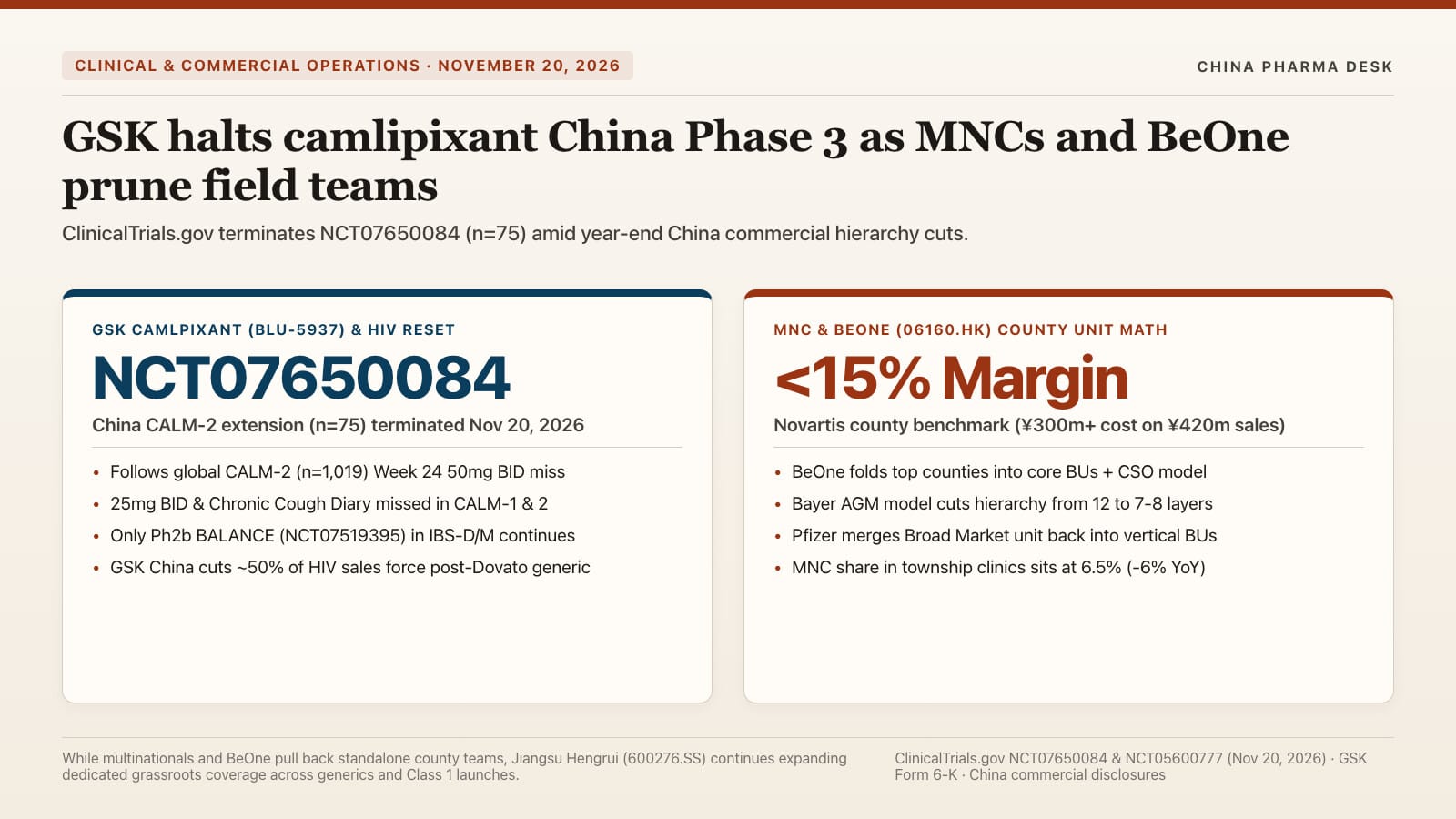
On November 20, 2026, GlaxoSmithKline (LSE/NYSE: GSK) formally updated ClinicalTrials.gov (NCT07650084) to mark its 24-week China Phase 3 extension study of selective P2X3 receptor antagonist camlipixant (BLU-5937) in refractory chronic cough (RCC) as TERMINATED after enrolling 75 participants across 25 mg BID, 50 mg BID, and placebo arms. The registry closure completes the China clinical wind-down of the centerpiece asset from GSK’s $2.0 billion (C$2.7 billion) acquisition of Bellus Health following the July 17, 2026 global CALM-2 (NCT05600777, n=1,019) Week 24 primary-endpoint miss, leaving only the Phase 2b BALANCE trial (NCT07519395) in irritable bowel syndrome (IBS-D and IBS-M) active.
On the exact same day, domestic industry disclosures confirmed that GSK China is cutting roughly half of its HIV commercial team after generic entry eroded margins on its oral two-drug regimen Dovato (dolutegravir/lamivudine) before long-acting injectable Cabenuva (cabotegravir + rilpivirine) could reach scale—part of a synchronized November 2026 reorganization across Bayer, Pfizer, Gilead, and BeOne Medicines (HKEX: 06160; SSE: 688235; NASDAQ: ONC) that is stripping middle-management layers and dismantling standalone county-hospital (xianyu) sales forces across China.
Why camlipixant’s China extension closed—and what remains of the P2X3 class
When GSK initiated the quadruple-masked CALM-2 China Extension (NCT07650084) on November 21, 2025, camlipixant (BLU-5937) was positioned as a high-selectivity P2X3 antagonist engineered to avoid the 60%+ rates of dysgeusia (taste disturbance) that led the U.S. FDA to issue two Complete Response Letters to Merck’s (NYSE: MRK) first-generation P2X3/P2X2/3 antagonist gefapixant (Lyfnua, approved in Japan, the EU, and China).
However, the aggregate readout from GSK’s two global Phase 3 trials (CALM-1 [NCT05599191, 52 weeks] and CALM-2 [NCT05600777, 24 weeks, n=1,019]) exposed a narrow therapeutic window:
- Dose-dependent and time-point fragility: While
camlipixant50 mg BIDachieved a statistically significant reduction in 24-hour ambulatory cough frequency versus placebo at Week 12 inCALM-1, the identical50 mg BIDdose failed to reach statistical significance at Week 24 inCALM-2. - Lower dose and patient-reported outcome failures: The
25 mg BIDarm failed to reach statistical significance in eitherCALM-1orCALM-2, and neither dose met prespecified thresholds on key secondary endpoints including the patient-reported Chronic Cough Diary (CCD). - China operational consequence (
NCT07650084): AlthoughNCT07650084tracked specificP2X3adverse events of medical interest—taste disturbance, oral hypoesthesia, oral paresthesia, and corneal findings—GSK halted the trial at 75 enrolled patients after concluding on July 17 that the limited aggregate efficacy would not transformRCCcare.
Multinationals and BeOne recalculate China field-force and county-market unit economics
Alongside pipeline pruning in respiratory medicine, November 20 disclosures detailed how multinational pharmaceutical companies (MNCs) and leading domestic biotechs are restructuring their China commercial organizations heading into the 2027 budget cycle. Unlike earlier waves of layoffs driven purely by Volume-Based Procurement (VBP) price cliffs on off-patent blockbusters, the late-2026 adjustments target organizational hierarchy compression and low-margin county-market (xianyu) teams:
Company (Ticker) |
November 2026 China Commercial Restructuring Action | Underlying Portfolio & Unit-Economics Driver |
|---|---|---|
GSK (LSE/NYSE: GSK) |
Cuts ~50% of China HIV commercial team alongside NCT07650084 (camlipixant RCC) termination |
Domestic first-generic launch against oral two-drug regimen Dovato (dolutegravir/lamivudine) compressed margins before long-acting injectable Cabenuva (cabotegravir/rilpivirine) scaled |
Bayer (ETR: BAYN) |
Rolls out AGM (Area General Manager) model in China general medicine; eliminates Regional Sales Manager (RSM) tier, compressing hierarchy from 12 layers to 7–8 layers |
Flattens mature primary-care overhead under tightened Medical Representative Management Measures compliance rules |
Pfizer (NYSE: PFE) |
Dissolves standalone Broad Market (Guangkuo Shichang / county) unit, merging county coverage back into vertical therapeutic Business Units (BUs) |
Eliminates duplicate regional management infrastructure separating core urban and county hospital tiers |
Gilead Sciences (NASDAQ: GILD) |
Trims commercial headcount across mature liver disease, anti-infective, and legacy oncology franchises | Reallocates China operating budget toward local clinical R&D, medical affairs, and market access |
BeOne Medicines (06160.HK / 688235.SS / ONC) |
Dismantles standalone County Market (Xianyu) unit; shifts on Nov 20 to “Core BU + CSO” dual-track model (high-potential county hospitals folded into core oncology BUs; lower-tier counties handed to CSOs) |
Avoids carrying fixed internal sales overhead in low-yield grassroots oncology territories while keeping top county cancer centers in-house |
Novartis (SIX: NOVN) (County benchmark) |
Previously consolidated county operations after county team spent >RMB 300 million in annual operating costs to generate RMB 420 million in 2024 revenue (<15% gross margin) |
Illustrates why standalone MNC county structures struggle: MNC share in township health centers sits at just 6.5% (-6% YoY) |
Jiangsu Hengrui (600276.SS / 01276.HK) (Counter-trend) |
Continues expanding dedicated in-house grassroots/county sales force | Broad basket of high-volume generics, surgical anesthetics, contrast media, and newly reimbursed Class 1 drugs amortizes per-rep fixed costs across multiple county hospital departments |
Why the 780-million-person county market failed the innovation ROI test
During the late 2010s, multinationals and domestic oncology biotechs built dedicated county-market divisions to chase China’s 780 million county and rural residents across roughly one million grassroots medical institutions. Operating data from 2024–2026 explain why both MNCs (Pfizer, Novartis, AstraZeneca) and domestic oncology leaders (BeOne) are now dismantling standalone county hierarchies:
- Volume grows, but revenue skews to low-priced chronic generics: While prescription volume at grassroots and county institutions grows faster than urban tertiary hospitals, grassroots channels represent only 24% of China’s total pharmaceutical market value. In township health centers (
xiangzhen weishengyuan), domestic companies occupy all top 20 spots, multinational market share has fallen to 6.5% (-6% YoY), and innovative oncology share has turned negative. - Diagnostic and physician-credential bottlenecks block complex therapies: As of year-end 2024, fewer than 50% of rural doctors (
xiangcun yisheng) held full licensed physician or assistant licensed physician (zhiye/zhuli yishi) credentials. Without pathology immunohistochemistry (IHC), next-generation sequencing (NGS), or adverse-event management infrastructure for immune-related toxicities, complex oncology and autoimmune biologics cannot be safely initiated at most lower-tier county facilities. - Sub-15% gross margins destroy standalone team economics: As Novartis’s disclosed county P&L (
>RMB 300 millionannual team cost againstRMB 420 millionin 2024 sales, yielding a<15%gross margin) demonstrated, maintaining a separate management pyramid for county hospitals erodes group operating margins. Even when four-ministry Notice No. 18 pushes tight-knit medical alliances (jinmixing yilianti) to synchronize Class 1 drug formularies down to county member hospitals, prescription initiation remains concentrated in the top 300 to 500 high-volume county general hospitals—which BeOne and Pfizer can cover directly through their core vertical oncology BUs while outsourcing the long tail to regional contract sales organizations (CSOs).
What to watch next
- ClinicalTrials.gov
NCT07519395(BALANCEPhase 2b): Whethercamlipixantdemonstrates visceral analgesic efficacy inIBS-DandIBS-Mafter GSK’s complete exit fromRCC(NCT05599191,NCT05600777,NCT07650084). - FY2026 selling-expense ratios at BeOne (
06160.HK) versus Hengrui (600276.SS): How BeOne’s transition to the “Core BU +CSO” county model affects its Q4 2026 and 1H 2027 China SG&A-to-revenue ratio as newly added 2026NRDLindications take effect on January 1, 2027.