China's 2026 NRDL moves relma-cel into basic insurance. The CAR-T divide remains.
NHSA Notice No. 29 of 2026 adds JW Therapeutics (HKEX: 02126) relmacabtagene autoleucel to basic insurance from January 2027, with defined lymphoma restrictions and hospital-access steps.
China’s National Healthcare Security Administration (NHSA) published its 2026 reimbursement lists on November 14, placing JW Therapeutics’ (HKEX: 02126) CD19 CAR-T therapy relmacabtagene autoleucel (relma-cel; JWCAR029; Carteyva, marketed in China as Beinuoda) in the basic-insurance catalogue. NHSA Notice No. 29 of 2026, signed November 13, makes the new lists effective January 1, 2027. Coverage is restricted to specified adult lymphoma populations; the commercial effect will depend on local cost sharing and treatment-centre implementation.
The important change is the payer behind an eligible treatment. A nationally listed basic-insurance medicine has a route to public-fund reimbursement. A product on the parallel commercial-insurance list still depends on the benefits of a patient’s commercial policy. Both lists can support hospital access, but their funding commitments differ.
From a September question to a November funding decision
The route to this decision was visible before the outcome was settled. In its September 9 coverage of the negotiations, E-Yao Manager reported JW Therapeutics’ participation in the basic-insurance talks while treating market expectations of CAR-T inclusion as unconfirmed. The publication’s September 10 repost preserves that distinction. The November 14 catalogue now supplies the formal product entry, reimbursement restrictions and effective date that the earlier reporting could not establish.
Together with relma-cel’s 2025 commercial-list inclusion, the sequence shows how the commercial route can precede basic-insurance access for a particular medicine. It gives manufacturers a concrete precedent for planning evidence and access work across the two systems. It does not create a fixed timetable for transfer: the commercial-list CAR-T products remaining in 2026 illustrate why the funding outlook still has to be assessed asset by asset.
Read the relma-cel row before modelling the market
The 2026 National Reimbursement Drug List (NRDL) identifies relma-cel as Category B negotiated entry 297, with an agreement running from January 1, 2027, through December 31, 2028. Its reimbursement row specifies three groups:
- Adults with relapsed or refractory large B-cell lymphoma after at least two systemic treatment lines. The listed subtypes are diffuse large B-cell lymphoma not otherwise specified, primary mediastinal large B-cell lymphoma, and high-grade B-cell lymphoma with MYC and BCL2 and/or BCL6 rearrangements.
- Adults with refractory follicular lymphoma, or follicular lymphoma relapsing within 24 months, after at least two systemic treatment lines; the specified histological grades are 1, 2 and 3a.
- Adults with relapsed or refractory mantle cell lymphoma after at least two systemic treatment lines, including a Bruton’s tyrosine kinase inhibitor.
These restrictions determine the reimbursable population. They cannot be replaced with an estimate covering every relma-cel prescription, every lymphoma patient or the entire CAR-T class. NHSA separately requires treatment to satisfy the approved label as well as the reimbursement conditions.
The payment-standard field carries an asterisk rather than a publicly displayed amount. The notice says negotiated standards include both the fund’s and the insured person’s contributions, with their split determined locally. Consequently, this document does not support a single nationwide patient bill or an inference that the fund pays the full treatment cost.
Two catalogues, different commercial exposures
JW Therapeutics had announced relma-cel’s inclusion in the first commercial-insurance catalogue in December 2025. Its move to basic insurance now provides a concrete example of progression between the two lists.
That progression is product specific. The 2026 commercial-insurance catalogue includes Fosun Kite’s CD19 CAR-T axicabtagene ciloleucel (Yikaida). It also includes CARsgen Therapeutics’ (HKEX: 02171) CLDN18.2 CAR-T satricabtagene autoleucel (CT041; satri-cel) for the specified previously treated gastric or gastroesophageal-junction cancer population. These entries establish payment-list status, not a comparison of clinical performance.
For commercial-list medicines, the notice expressly excludes payment by the basic medical-insurance pooling fund and the work-injury insurance fund. Insurers are encouraged to incorporate the catalogue into product design and claims coverage. Listing alone does not amend every existing policy.
The NHSA results announcement reports 107 additions to basic insurance, including 51 Class 1 innovative drugs, and a final catalogue of 3,331 medicines. The commercial list adds 12 medicines and reaches 28; two medicines from the 2025 commercial list move to basic insurance. The parallel system therefore remains in place even as individual products change lanes.
Hospital incentives survive the transfer
The notice preserves the relevant commercial-list support policies for two agreement periods, or four years, after a medicine transfers to basic insurance. That provision matters because a reimbursement entitlement and a hospital’s willingness to initiate treatment are separate operational questions.
Commercial-list support includes exclusions from specified hospital self-pay and volume-based-procurement substitution monitoring. The notice also allows cases involving commercial-list drugs within commercial-policy coverage to be kept outside disease-based payment after review. The four-year continuation provision should be read with the underlying support policies; it is not a promise of an automatic, unconditional payment exemption for every transferred medicine.
For reasonable use of NRDL medicines that does not fit standard disease-based payment, hospitals can request case-by-case assessment. Authorities may then pay by service or adjust the case standard. This offers an implementation route for expensive treatment episodes, while retaining an application and review step.
For JW, broader payer eligibility could help convert clinically eligible referrals into funded treatments. The economic result remains conditional: reimbursed volume, the negotiated realization per treatment, local patient contributions and the capacity to deliver treatment must be assessed together. A larger eligible pool alone does not establish higher product revenue or margin.
The next three checkpoints
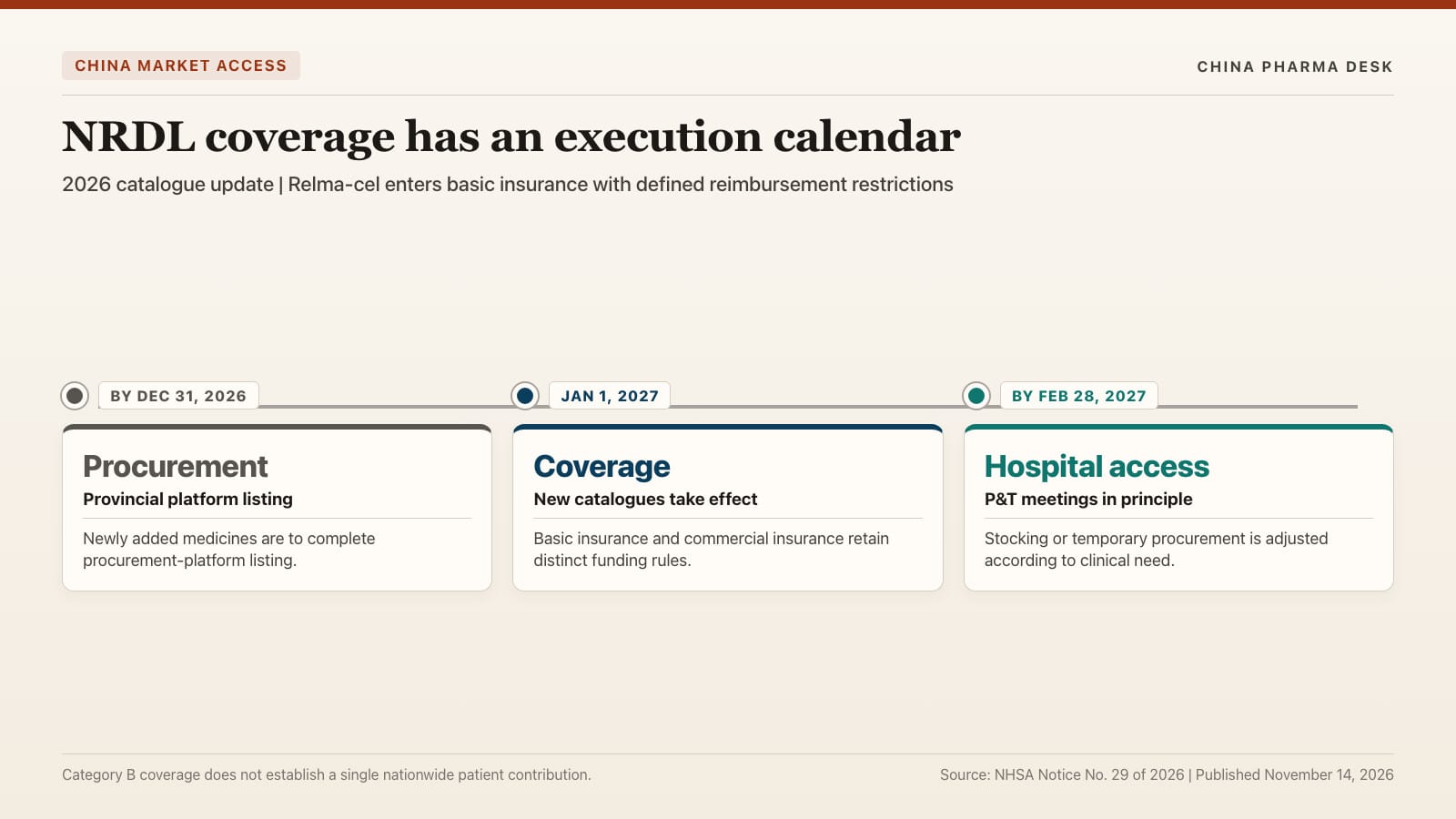
The implementation calendar gives market-access teams specific work to track. Newly added medicines are to complete provincial procurement-platform listing by the end of December 2026. The reimbursement switch follows on January 1, 2027. Designated institutions should, in principle, convene pharmacy and therapeutics committees by the end of February 2027 and adjust stocking or temporary procurement arrangements according to need.
Our earlier analysis of China’s hospital-formulary policy explains the access problem these measures address; the China pharma glossary distinguishes NRDL coverage, hospital listing and payment mechanisms. For relma-cel, the first useful execution evidence will be provincial listing records, local reimbursement instructions and treatment-centre arrangements that make the new entitlement usable.
Updated November 14, 2026: Added historical negotiation reporting and analysis of the commercial-to-basic-insurance pathway.