Weekly R&D and Compliance Ledger: Hengrui's 81% liver-fat drop meets Guangxi dual probes
China Pharma Desk's Nov 21, 2026 ledger covers Hengrui's (600276.SS) 81.0% AASLD liver-fat drop on HRS-4729 (NCT06762600) and herombopag sNDA (CXHS2600158), GenSci161, and CSRC/FDA probes in Guangxi.
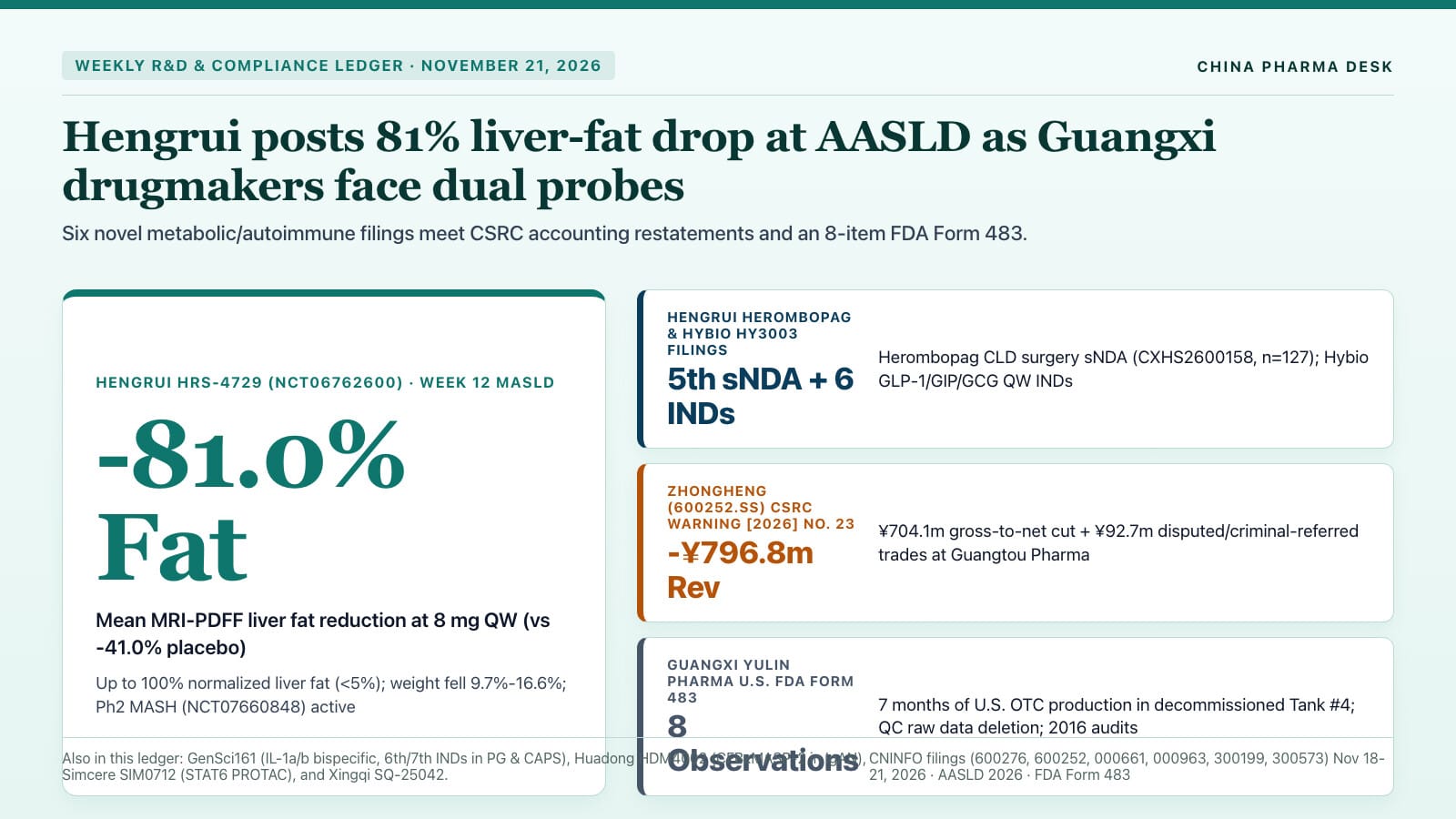
Between November 18 and November 21, 2026, domestic statutory filings on CNINFO, clinical readouts from the 77th American Association for the Study of Liver Diseases (AASLD) Annual Meeting, and newly released U.S. and Chinese regulatory enforcement notices converged across two distinct tracks. On the R&D front, six Chinese drugmakers—led by Jiangsu Hengrui Pharmaceuticals (SSE: 600276; HKEX: 01276), Changchun High-Tech / GenSci (SZSE: 000661), Huadong Medicine (SZSE: 000963), Hybio Pharmaceutical (SZSE: 300199), Simcere Pharmaceutical (HKEX: 02096), and Shenyang Xingqi Ophthalmic (SZSE: 300573)—advanced multi-target biologics, PROTAC degraders, and GLP-1/GIP/GCG triple agonists across metabolic liver disease and rare autoinflammatory disorders. Over the same 48-hour window, two flagship pharmaceutical groups in Guangxi Province were hit by severe domestic and U.S. compliance enforcement: Guangxi Wuzhou Zhongheng Group (SSE: 600252, Notice Lin 2026-97) received its second China Securities Regulatory Commission (CSRC) warning letter of 2026 ([2026] No. 23) over RMB 796.80 million in restated distribution revenues and a criminal contract-fraud referral, while Consun Pharmaceutical Group (HKEX: 01681) subsidiary Guangxi Yulin Pharmaceutical was cited in an eight-observation U.S. FDA Form 483 for manufacturing U.S.-bound over-the-counter (OTC) batches inside a decommissioned formulation tank for seven consecutive months.
This weekend deep-dive dissects the clinical mechanisms, trial architectures, and forensic accounting/cGMP records behind both waves of disclosures.
Summary matrix: Nine late-week pipeline, generic, and compliance disclosures (Nov 18–21, 2026)
Company (Ticker) |
Asset / Facility & Filing Code | Modality / Regulatory Category | Core Clinical or Enforcement Metric | Next Evidence Trigger |
|---|---|---|---|---|
Jiangsu Hengrui (600276.SS / 01276.HK) |
HRS-4729 (NCT06762600 Ph1 MAD / NCT07660848 Ph2) |
Once-weekly SC GLP-1/GIP/GCG triple receptor agonist |
Week 12 mean MRI-PDFF liver fat drop -81.0% at 8 mg (vs. -41.0% placebo) in n=34 MASLD + obesity subgroup; up to 100% <5% liver fat normalization; weight -9.7% to -16.6% |
Phase 2 MASH (NCT07660848) biopsy and MRI-PDFF readout |
Jiangsu Hengrui (600276.SS / 01276.HK) |
herombopag olamine (Hengqu) (Lin 2026-182, CXHS2600158) |
Oral non-peptide TPO-R agonist (5th indication sNDA) |
Phase 3 SHR8735-302 (n=127, 21 China centers) met primary endpoint in CLD thrombocytopenia prior to elective invasive procedures; cumulative R&D RMB 668.20m |
NMPA approval decision (2027) vs. avatrombopag (Doptelet) and lusutrombopag (Mulpleta) |
Hybio Pharma (300199.SZ) & Qilu Pharma |
HY3003 Injection (2026-077, 2026LP03570–03575) & QLS7402 (NCT07950462) |
Once-weekly SC GLP-1R/GIPR/GCGR triple agonist (HY3003) & obesity biologic (QLS7402) |
6 NMPA IND approvals (CXHL2601095–1100) for HY3003 weekly SC weight management (joining active U.S. FDA IND + China oral tablet IND); Qilu registers 140-patient Ph1 for QLS7402 |
Phase 1 human dosing and weight-loss readouts for weekly SC and oral HY3003 |
Changchun High-Tech / GenSci (000661.SZ) |
GenSci161 Injection (2026-106, CXSL2601287 & CXSL2601288) |
Class 1 fully human IgG1 bispecific antibody targeting IL-1α + IL-1β |
NMPA accepted 6th & 7th IND applications in pyoderma gangrenosum (PG) and CAPS (FCAS/MWS/NOMID), expanding beyond EM, HS (U.S. + China IND), NIU, CTD-ILD, and RP |
60-working-day CDE implied IND clearance (~Feb 2027) and Phase 1/2 rare-disease basket data |
Huadong Medicine (000963.SZ) |
HDM4002 Injection (2026-064, 2026LP03558 / CXSL2600971) |
Class 1 bispecific antibody targeting CFB + MASP-2 |
NMPA approved Phase 1 IND in adult primary IgA nephropathy (IgAN) to dual-block alternative (CFB) and lectin (MASP-2) complement pathways |
First-in-human Phase 1 dosing and 24-hour UPCR / eGFR biomarker data |
Simcere Pharma (02096.HK) |
SIM0712 Capsules (Nov 16–20 disclosure) |
Oral CRBN-recruiting STAT6 PROTAC degrader |
NMPA approved IND for atopic dermatitis (AD); selectively binds STAT6 SH2 domain (sparing STAT1/STAT5) to block IL-4 and IL-13 Type 2 inflammation |
Phase 1 healthy-volunteer and AD patient STAT6 degradation kinetics |
Shenyang Xingqi (300573.SZ) |
SQ-25042 Intravitreal Solution (2026-070, 2026LP03584–03586) |
Class 1 fusion-protein intravitreal biologic | Simultaneous NMPA IND approvals across nAMD (LP03584), DME (LP03585), and RVO macular edema (LP03586) |
Phase 1 intravitreal dosing and durability intervals vs. faricimab / aflibercept |
Guangxi Wuzhou Zhongheng (600252.SS) |
Subsidiary Guangtou Pharma & Group (Lin 2026-97 / Lin 2026-58) |
CSRC Guangxi Bureau Warning Letter [2026] No. 23 (Nov 20, 2026) |
Cited for 2023–2025 asset-impairment & revenue errors: RMB 704.14m gross-to-net cut + RMB 92.66m reversal on 5 disputed/criminal-referred distribution clients | Nanning PSB criminal fraud investigation outcome & FY2026 audit opinion |
Consun (01681.HK) / Guangxi Yulin Pharma & Daiichi Sankyo EU |
Yulin OTC Plant (8-item FDA 483) & Daiichi EU Plant (3-item FDA 483) |
U.S. FDA cGMP inspection enforcement (21 CFR Part 211) |
Yulin: 7 months of U.S. OTC production in red-tagged Tank #4, release without active % assay, QC raw data deletion, no API vendor audits since 2016; Daiichi EU: uncontrolled Empower manual integration |
Potential FDA Warning Letter or Import Alert 66-40 for Guangxi Yulin Pharmaceutical |
1. Metabolic and liver-hematology expansion: Hengrui’s HRS-4729, herombopag, and Hybio’s HY3003
HRS-4729 delivers up to 81.0% Week 12 liver defatting at AASLD 2026
Following our earlier coverage of Boehringer Ingelheim’s survodutide, Novo Nordisk’s semaglutide, and Alnylam’s ALN-CIDEB at AASLD 2026 and Hengrui’s HRS-5635 hepatitis B readout, Hengrui released the full post-hoc subgroup dataset from the oral presentation of its once-weekly subcutaneous GLP-1/GIP/GCG triple receptor agonist HRS-4729 (first-in-human Phase 1 trial NCT06762600, led by Professor Wen Qing and presented by Director He Kun of Jinan Central Hospital).
While GLP-1 and GIP agonism reduce hepatic lipid influx indirectly through systemic weight loss and insulin sensitization, direct activation of hepatic glucagon (GCG) receptors stimulates mitochondrial β-oxidation and suppresses de novo lipogenesis inside hepatocytes. In the multiple-ascending-dose (MAD) cohort of NCT06762600, 48 overweight or obese adults (aged 18–55, BMI 28–40 kg/m²) were randomized to 12 weeks of once-weekly subcutaneous HRS-4729 (1 mg fixed dose, or titrated to target doses of 4 mg, 8 mg, or 12 mg) or placebo. Among the 34 participants with baseline metabolic dysfunction-associated steatotic liver disease (MASLD, defined as magnetic resonance imaging proton density fat fraction [MRI-PDFF] >= 5%):
- Dose-dependent relative liver fat reduction: At Week 12, mean percentage change from baseline in
MRI-PDFFliver fat ranged from-41.0%to-81.0%acrossHRS-4729dose cohorts, peaking at-81.0%in the8 mggroup compared with-41.0%in the placebo group (the12 mgcohort entered with a lower mean baseline liver fat of8.5%, creating a floor effect). - Higher baseline steatosis yielded deeper clearance: Among participants with baseline
MRI-PDFF >= 8%and>= 10%, maximum mean relative liver fat reductions reached82.6%and89.8%, respectively. - Complete steatosis resolution (
<5%liver fat): Across the4 mg,8 mg, and12 mgtitrated cohorts, the proportion of participants achieving ≥ 30%, ≥ 50%, and ≥ 70% relative liver fat reductions reached up to100%, and up to100%of treated participants normalized absolute hepatic fat content below the 5% radiographic steatosis threshold. - Anthropometric and safety profile: Over the same 12-week window,
HRS-4729reduced mean body weight by-9.7%to-16.6%(versus-4.8%for placebo) and shrank waist circumference by-8.7to-14.8 cm(versus-6.7 cmfor placebo), alongside reductions in triglycerides, total cholesterol, andLDL-C. All treatment-emergent adverse events (TEAEs) were mild to moderate (predominantly gastrointestinal nausea and vomiting), with zero serious adverse events (SAEs) and zero treatment discontinuations. Hengrui is already evaluatingHRS-4729in a dedicated Phase 2 metabolic dysfunction-associated steatohepatitis (MASH) trial (NCT07660848).
Meanwhile, on November 20, Hybio Pharmaceutical (300199.SZ, Notice 2026-077) received six NMPA clinical trial approval notices (2026LP03570 through 2026LP03575; acceptance numbers CXHL2601095–CXHL2601100) for its own once-weekly subcutaneous GLP-1R/GIPR/GCGR triple agonist HY3003 injection in adult weight management. Hybio is pursuing a three-formulation strategy for HY3003—combining the newly cleared China weekly injection (which already holds an active U.S. FDA IND), a once-daily oral tablet (China IND accepted), and a preclinical monthly extended-release depot—claiming superior weight loss at equimolar doses in diet-induced obese (DIO) mice over both dual agonist tirzepatide and triple agonist retatrutide.
Herombopag (CXHS2600158) targets the peri-procedural CLD thrombocytopenia market
In a separate statutory filing on November 21 (Lin 2026-182), Hengrui announced that the NMPA accepted a supplemental New Drug Application (sNDA, CXHS2600158) for its oral non-peptide thrombopoietin receptor (TPO-R) agonist herombopag olamine (Hengqu) in adults with chronic liver disease (CLD)-associated thrombocytopenia scheduled to undergo elective invasive procedures (including diagnostic procedures).
Backed by RMB 668.20 million in cumulative R&D investment, the filing rests on the multicenter, randomized, double-blind, placebo-controlled Phase 3 SHR8735-302 trial (n=127 across 21 Chinese hospitals led by Professor Zhou Jian at Fudan University Zhongshan Hospital), which met its primary efficacy endpoint in August 2026 by reducing the need for peri-procedural platelet transfusions. Two commercial and clinical details stand out in the filing:
- Unifying five
TPO-Rindications under one patented Class 1 tablet:Herombopagis already approved in China across four hematology and oncology indications—chronic primary immune thrombocytopenia (ITP, adults and children ≥ 6 years, where it will now compete with HUTCHMED’s newly approvedSYKinhibitorsovleplenib/SYVIK), immunosuppressant-refractory severe aplastic anemia (SAA), first-lineSAA( ≥ 15 years) combined with immunosuppressive therapy, and chemotherapy-induced thrombocytopenia (CTIT) in solid tumors. Adding peri-proceduralCLDallows Hengrui to challenge Fosun Pharma (600196.SS/02196.HK) and AkaRx’savatrombopag(Doptelet) and Shionogi / Eddingpharm’slusutrombopag(Mulpleta)—a global class that generated$2.222 billionin 2025 sales according to EvaluatePharma data cited in the filing. - Explicit portal vein thrombosis (
PVT) label guardrail: Because up to 78% of cirrhotic patients suffer from thrombocytopenia alongside sluggish portal venous flow, chronicTPO-Rover-stimulation risks portal vein thrombosis. Hengrui’s proposed indication text explicitly mandates: “Except for application scenarios within the scope of the indication,CLDpatients must not take this product to restore normal platelet counts.”
2. Dual-pathway autoimmune, renal, and retinal biologics: GenSci, Huadong, Simcere, and Xingqi
Four additional IND clearances and acceptances between November 18 and November 21 highlight how Chinese R&D teams are moving from single-target “me-too” antibodies to bispecific pathway blockade and targeted protein degradation (PROTAC) in non-oncology indications:
- Changchun High-Tech / GenSci (
000661.SZ, Notice2026-106) —GenSci161(IL-1α+IL-1βbispecificIgG1) reaches seven autoinflammatory indications: On November 21,NMPAaccepted two newINDfilings forGenSci161in pyoderma gangrenosum (PG,CXSL2601287)—a rare neutrophilic ulcerative dermatosis (3–10 cases per million/year, where onlyadalimumabin Japan holds a specific approval globally and zero drugs are approved in China)—and cryopyrin-associated periodic syndromes (CAPS,CXSL2601288), anNLRP3gain-of-function inflammasomopathy (2.7–5.5 per millionprevalence spanningFCAS, Muckle-Wells syndrome[MWS], andNOMID/CINCA). Unlike Novartis’s (SIX: NOVN)canakinumab(Ilaris), which neutralizes onlyIL-1β,GenSci161simultaneously neutralizes bothIL-1α(released as a damage-associated alarmin from necrotic epidermal and endothelial cells) andIL-1β. GenSci has now amassed sevenINDfilings forGenSci161—with ChinaINDsalready approved in endometriosis (EM), hidradenitis suppurativa (HS), non-infectious uveitis (NIU), and connective tissue disease-associated interstitial lung disease (CTD-ILD), a U.S. FDAINDapproved inHS, and a ChinaINDaccepted in recurrent pericarditis (RP)—building a rare immunology franchise to diversify Changchun High-Tech beyond somatropin growth hormone. - Huadong Medicine (
000963.SZ, Notice2026-064) —HDM4002(CFB × MASP-2bispecific antibody) inIgAnephropathy: On November 18, wholly-owned subsidiary Zhongmei Huadong receivedNMPAPhase 1INDapproval (2026LP03558,CXSL2600971) forHDM4002in adult primaryIgAnephropathy (IgAN). Under the “Four-Hit” pathogenesis ofIgAN, mesangial deposition of galactose-deficientIgA1(Gd-IgA1) immune complexes activates both the complement alternative pathway (driven by Complement Factor B[CFB]) and the lectin pathway (driven byMASP-2). While single-pathway agents such as Novartis’s oralCFBinhibitoriptacopan(Fabhalta) or Omeros’s anti-MASP-2antibodynarsoplimableave the parallel cascade unblocked,HDM4002is engineered to clamp both the initiation (MASP-2) and amplification (CFB) loops in a single bispecific molecule. - Simcere Pharmaceutical (
02096.HK) —SIM0712(oralSTAT6PROTACdegrader) in atopic dermatitis: Simcere secured ChinaINDclearance forSIM0712, an oral heterobifunctionalPROTACthat binds theSH2domain of signal transducer and activator of transcription 6 (STAT6) and recruits theCRBNE3 ubiquitin ligase to degradeSTAT6via the ubiquitin-proteasome system (while sparingSTAT1andSTAT5). Because bothIL-4andIL-13receptors signal obligately throughSTAT6to drive Type 2 inflammation,IgEclass switching, and epidermal barrier disruption, oralSTAT6degradation aims to replicate the dualIL-4Rαblockade of Sanofi and Regeneron’s injectabledupilumab(Dupixent) in a once-daily capsule. - Shenyang Xingqi Ophthalmic (
300573.SZ, Notice2026-070) —SQ-25042fusion-protein intravitreal injection: On November 20, Xingqi received three simultaneousNMPAINDapprovals for Class 1 fusion proteinSQ-25042across neovascular age-related macular degeneration (nAMD,2026LP03584), diabetic macular edema (DME,2026LP03585), and macular edema secondary to retinal vein occlusion (RVO,2026LP03586). Just one week after Zhaoke Ophthalmology (06622.HK) wonNMPAapproval for its nightly0.05%cyclosporine ophthalmic gelJingyoulingagainst Xingqi’s daytimeZirun,SQ-25042marks Xingqi’s first expansion from anterior-segment topical drops into posterior-segment retinal biologics. - Export API & domestic generic clearances (
600488.SS,600521.SS,688799.SS): Rounding out the week’s statutory filings, Tianjin Tianyao Pharmaceuticals (SSE: 600488, Notice2026-076) received a U.S. FDA Drug Master File (DMF) First Adequate Letter (DMF #033893, submitted September 2019; RMB 3.00 million R&D spend) for corticosteroid APIbetamethasone($835 millionglobal single-agent formulation market in 2025 perIQVIA); Zhejiang Huahai Pharmaceutical (SSE: 600521, NoticeLin 2026-119) won Class 3 generic approval (Guoyao Zhunzi H20266613; RMB 4.24 million R&D spend) for postoperative analgesicketorolac tromethamineinjection (1 mL:30 mg; RMB 88 million 1H 2026 China hospital sales); and Hunan Warrant Pharmaceutical (SSE: 688799, Notice2026-070) won Class 4 generic approval (Guoyao Zhunzi H20266646,CYHS2501454) for gastric mucosal protectantteprenonecapsules (50 mg).
3. Dual Guangxi compliance crackdown: Zhongheng’s RMB 796.8m revenue reversal and Yulin Pharma’s 8-item FDA Form 483
In sharp contrast to the clinical pipeline milestones above, two established pharmaceutical manufacturers headquartered in Guangxi Province—state-backed Guangxi Wuzhou Zhongheng Group (600252.SS, maker of Xueshuantong freeze-dried panax notoginseng saponins) and Consun Pharmaceutical (01681.HK) subsidiary Guangxi Yulin Pharmaceutical (maker of Zhenggushui and Shiduqing)—became the focus of domestic securities and U.S. FDA cGMP enforcement on November 20 and 21.
CSRC Guangxi Bureau Warning Letter [2026] No. 23 at Zhongheng Group (600252.SS): Gross-to-net inflation and suspected criminal distribution fraud
On November 21 (Lin 2026-97), Zhongheng Group disclosed that on November 20 it received Administrative Regulatory Measure Decision [2026] No. 23 from the CSRC Guangxi Bureau, issuing a formal Warning Letter (Jingshihan) and Integrity Archive record against the company, current Chairman Yang Jinhai, and former CFO Ge Hui for improper asset-impairment accounting and inaccurate revenue-recognition methods across 2023, 2024, and 2025.
Cross-referencing Lin 2026-97 with Zhongheng’s prior restatement filing (1225022354.PDF, March 21, 2026) and its Shanghai Stock Exchange Annual Report Inquiry Reply (Lin 2026-58, July 8, 2026) exposes the exact mechanics of how traditional Chinese medicine (TCM) companies inflate top-line distribution revenue when core injectable hospital volumes come under procurement pressure:
- RMB 704.14 million in improper gross-method (
Zong'efa) revenue booking: Under China Accounting Standard No. 14 (CAS 14 Article 34), a distributor may book full gross revenue (principalbasis) only if it takes physical control, inventory risk, and pricing authority before transferring goods; otherwise, it must book only the net agency fee (netbasis). Between 2023 and 3Q 2025, Zhongheng booked API, ejiao (donkey-hide gelatin), non-stocked sanqi/dilong herbal trades, and drop-shipped health foods, household chemicals, and medical devices—where suppliers shipped directly to customers without Zhongheng handling logistics or retaining bills of lading—on a 100% gross basis, including trades with overlapping customer-supplier counterparties. Following regulatory scrutiny, Zhongheng was forced to restate those trades to a net basis, wiping out RMB 127.89 million of reported revenue in FY2023, RMB 166.06 million in FY2024, and RMB 410.18 million in 9M 2025 (RMB 704.14 million cumulative). - RMB 92.66 million in reversed wholesale trades referred to Economic Crime Police (
Jingzhen): Even more damaging, Zhongheng’s distribution subsidiaryGuangtou Pharmaceutical(Guangxi Investment Pharmaceutical) booked RMB 92.66 million in 9M 2025 gross pharmaceutical sales (and RMB 87.22 million in unpaid receivables) across five regional wholesalers all introduced by the exact same intermediary:Guangxi Qucaotang Pharmaceutical Logistics: RMB 32.57 million net revenue (RMB 36.80mtax-inclusive;RMB 24.73munpaid balance; sourced fromGuangxi Jointown);Guangxi Haixing Pharmaceutical(formerlyGuangxi Neptunus Galaxy): RMB 17.73 million (RMB 19.34munpaid; sourced fromGuangxi Jointown);Guangxi Du'an Jianxing Pharmaceutical: RMB 16.75 million (RMB 18.92munpaid; circularly sourced fromQucaotang,Fudi Huaren,Sinopharm Guangxi, andHaixing);Guangxi Fudi Huaren Pharmaceutical: RMB 15.24 million (RMB 12.03munpaid); andYunnan Pharmaceutical Technology Development: RMB 10.38 million (RMB 10.19munpaid).
When Qucaotang defaulted in 2025 and Guangtou Pharmaceutical filed a civil collection lawsuit, both first- and second-instance courts dismissed the civil suit on grounds of suspected criminal contract fraud and ordered the case transferred on May 12, 2026 to the Nanning Public Security Bureau Jiangnan Branch Economic Crime Investigation Brigade—forcing Zhongheng to reverse the entire RMB 92.66 million in revenue (and RMB 1.84 million in net profit) and triggering two successive CSRC warning letters ([2026] No. 5 in June and [2026] No. 23 on November 20).
U.S. FDA Form 483 at Guangxi Yulin Pharmaceutical (8 Observations) and Daiichi Sankyo Europe (3 Observations)
While CSRC policed financial reporting in Wuzhou, newly released U.S. FDA Form 483 inspection reports highlighted quality-system breakdowns at Guangxi Yulin Pharmaceutical Group (a subsidiary of Hong Kong-listed Consun Pharmaceutical 01681.HK; inspected March 17–21, 2025, with an 8-observation Form 483 issued to Chairman Guo Guorong) and Daiichi Sankyo (TSE: 4568) Europe’s formulation plant (inspected July 14–18, 2025; 5-page amended Form 483 with 3 observations):
| Facility & Inspection Window | Cited 21 CFR Part 211 / cGMP Observation |
Operational & Regulatory Detail Verified in Form 483 |
|---|---|---|
Guangxi Yulin Pharmaceutical (Consun 01681.HK, Mar 17–21, 2025; 8 observations) |
Obs. 5 — Continued Production in Decommissioned Tank (211.100(b)) |
After receiving a formal notice to stop using Formulation Tank #4, the plant failed to open a deviation or suitability evaluation and continued manufacturing batches in Tank #4 for 7 consecutive months until replacement; 100% of those batches were exported to the U.S. |
| Guangxi Yulin Pharmaceutical | Obs. 1 & Obs. 3 — OTC Release & Stability Without Assay (211.165(a) / 211.166(a)) |
Exported OTC drug batches were released to the U.S. market without testing active-ingredient concentration against labeled % specs (reporting mg/mL without verifying label %), and lacked any written stability-testing protocol or stability-indicating assay |
| Guangxi Yulin Pharmaceutical | Obs. 2 — Data Integrity & Missing Audit Trails (211.160(b)) |
Analytical laboratory software lacked electronic audit trails, allowing QC personnel to freely delete raw analytical data; test methods were unvalidated and internal standards conflicted with the Chinese Pharmacopoeia |
| Guangxi Yulin Pharmaceutical | Obs. 4, 6, 7 & 8 — 2016 Vendor Audits, Cleaning & Yield (211.84 / 211.67 / 211.125) |
Most recent API supplier audit record dated back to 2016 (9-year gap) with SOP edits bypassing change control (Obs. 7); unvalidated batch-size yield limits (Obs. 4), unvalidated cleaning hold times (Obs. 6), and missing packaging label reconciliation (Obs. 8) |
| Daiichi Sankyo Europe Formulation Plant (July 14–18, 2025; 3 observations) | Obs. 1, 2 & 3 — Uncontrolled Empower Manual Integration & OOS Invalidation |
Laboratory lacked an SOP governing Empower chromatography manual integration, with widespread manual peak re-integration performed without justification, authorization, or audit-trail review (Obs. 1); two content-uniformity OOS results invalidated without analyst interviews (Obs. 2); visible material residue on gaskets and chipped tablet punches on equipment logged as cleaned (Obs. 3) |
For global supply-chain and quality teams, Yulin Pharmaceutical’s eight-item Form 483—combining seven months of production in a red-tagged vessel with raw data deletion and a nine-year gap in API vendor audits—carries a high probability of escalating into an FDA Import Alert (66-40, detention without physical examination of unapproved/cGMP-deficient drugs) or a formal Warning Letter in late 2026 or early 2027.