China's new drug rules target the gap between insurance and hospital access
Four-agency Notice No. 18 of 2026 links hospital access with payment review and safe use. NHSA Notice No. 29 adds the 2027 implementation calendar and broader negotiated-drug support.
China’s health and insurance authorities are trying to close the gap between a medicine entering an insurance catalogue and a hospital being able to prescribe it. The four-agency Notice No. 18 of 2026, signed October 30 and publicized November 10, connects formulary access with payment review, clinical evaluation and safe use. With the 2026 insurance catalogues published on November 14, the commercial question is how those provisions translate into treatment that hospitals can actually deliver.
The policy changes the basis for an access discussion. For eligible products, a numerical limit or performance measure should no longer serve as a convenient substitute for evaluating clinical need. The hospital still has to establish which patients should receive the medicine, whether it can provide the necessary care and how the episode will be paid for. Those decisions remain consequential after a product wins catalogue entry.
The policy removes different barriers for different groups
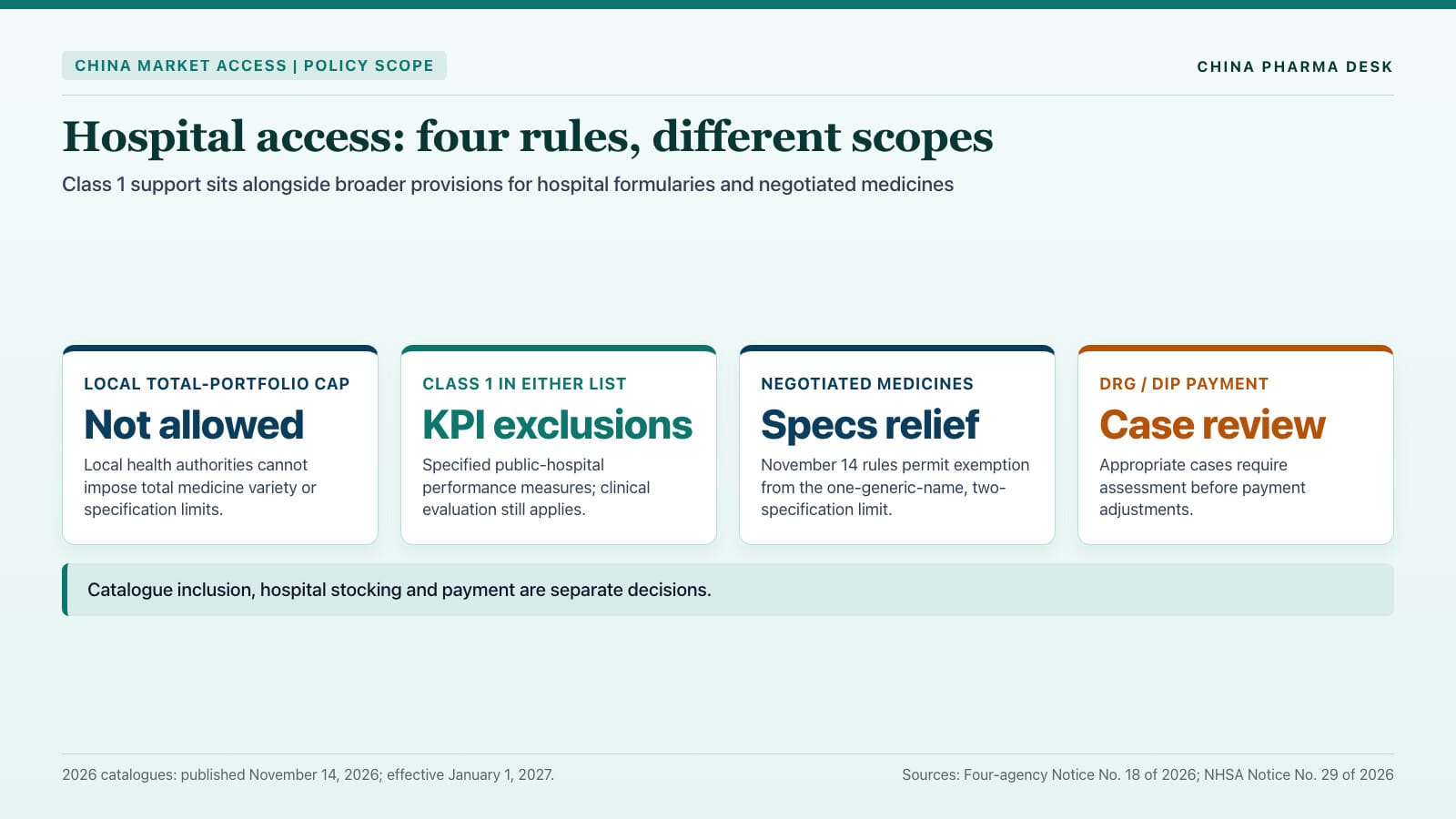
The four-agency notice, reproduced in full by Shanghai’s drug regulator, is often summarized as a package for Class 1 new drugs. The two lists referenced by that package are the nationally negotiated-drug list and the Commercial Health Insurance Innovative Drug List. A useful access strategy needs a provision-by-provision map.
| Provision | Stated scope |
|---|---|
| No local-authority ceiling on total medicine varieties or specifications | The prohibition has no Class 1 qualifier |
| One-generic-name, two-specification exclusion under Notice No. 18 | Class 1 new drugs in either insurance catalogue |
| Named performance-monitoring exclusions and regular stocking/use monitoring | The same catalogue-listed Class 1 group |
| Case review for appropriate basic-insurance use that does not fit disease-based payment | Innovative medicines in the basic-insurance catalogue; this clause is not written as Class-1-only |
The named performance measures include essential-medicine shares and growth in average outpatient and inpatient drug expenditure. Removing an eligible product from those calculations can reduce an administrative reason to reject it. It does not remove the cost of buying and using the medicine from the hospital’s accounts.
A separate, broader route appears in NHSA Notice No. 29 of 2026, published November 14. It permits negotiated medicines to be exempt from the one-generic-name, two-specification limit and rejects budget, formulary-number and drug-cost-ratio barriers to implementation. That wording is not confined to Class 1.
The practical implication is that registration category, catalogue status and the individual provision must be checked separately. A non-Class-1 negotiated medicine may have a specification-related access argument without sharing the targeted Class 1 performance exclusions. A medicine outside the targeted package must build its case using the provisions and clinical evidence applicable to it.
Formulary access becomes a test of clinical readiness
The notice links hospital listing to capability and conditions, retains clinical evaluation and prescription review, and calls for information-system updates. It also supports coordination within tightly integrated medical alliances according to need.
These requirements explain why “on the list” and “available to the patient” can remain different states. A favourable committee decision still has to become an operational prescribing route. The hospital needs a defined eligible population, the ability to provide treatment and a working process across pharmacy, clinical services and payment administration.
For manufacturers, this points to a more useful hospital submission. Alongside evidence of policy eligibility, the dossier should explain the medicine’s place in the hospital’s treatment pathway, the evidence relevant to its patient population, the resources required for use and the arrangements for managing known risks. Those are practical implications of the notice, rather than a new statutory checklist imposed on companies.
The distinction is visible in JW Therapeutics’ (HKEX: 02126) relmacabtagene autoleucel (relma-cel; JWCAR029), a CD19 CAR-T entering basic insurance. Its reimbursement entry specifies lymphoma populations and prior-treatment conditions. An access assessment therefore has to connect the funded population with a capable treatment institution. Counting procurement listings alone would miss that operational requirement.
Payment review is a separate economic decision
A performance-monitoring exclusion can make a hospital less reluctant to use an eligible medicine. It cannot, by itself, determine whether a DRG/DIP case payment covers the treatment episode.
The four-agency notice provides for monthly or quarterly case assessment where appropriate use of an innovative medicine in basic insurance does not fit standard disease-based payment. Adjustment follows review. The commercial-insurance route also retains an assessment step; commercial-list status does not create a commitment by the basic-insurance fund to pay for the drug.
That distinction matters to implementation. Clinical and pharmacy teams may support a product while the hospital still needs a workable payment arrangement for a particular case. Repeating a performance-exemption clause does not answer the payment question. The relevant evidence must explain why the case qualifies for assessment and how the treatment fits the applicable coverage rules.
Nor does a payment adjustment establish that every prescription will be funded on identical terms. The policy makes a route available; its use must be demonstrated through the decisions made under that route.
Safety support is part of access execution
The notice combines prescribing oversight with training and guidance. It asks Phase 3 lead hospitals to organize clinical-use consensus documents within six months of the relevant Class 1 medicine entering the catalogues.
That gives implementation a clinical follow-through beyond procurement. Where the eligible population, monitoring needs and treatment pathway are clear, a hospital has a stronger basis for sustained use. Where those arrangements are incomplete, listing can remain an administrative milestone.
Companies can prepare evidence and support appropriate scientific exchange, while prescribing and formulary decisions remain with the institutions responsible for care. A template copied across hospitals is unlikely to answer differences in clinical capability or local payment administration.
The medical-alliance provisions should be read in the same way. They support coordination and need-based stocking, but do not prescribe one national model of centralized inventories, remote consultation or cross-institution medicine transfers. Those operating arrangements need their own applicable rules.
The next evidence arrives on several clocks
The November 14 implementation notice makes the 2026 catalogues effective on January 1, 2027. Newly added medicines are to complete provincial procurement-platform listing by the end of December 2026; designated institutions should, in principle, hold pharmacy meetings by the end of February 2027 and adjust supply according to need. The clinical-consensus task runs on a separate clock linked to catalogue inclusion.
For market-access teams, these are different execution milestones. For investors and industry observers, they are also different levels of evidence. A platform listing shows procurement availability; a formulary and information-system update shows an institutional prescribing route; reviewed payment cases and continued appropriate use provide stronger evidence that the route is working.
The useful question after catalogue publication is therefore whether clinical demand, institutional capability and payment have been connected for the eligible patients. The China pharma glossary distinguishes these mechanisms, while the coming provincial and hospital records will show how consistently they operate.
Updated November 14, 2026: Reworked into a full analysis of hospital access, payment and implementation. The earlier graphic’s reference to spending caps has been corrected to performance-monitoring exclusions.