Hengrui's HRS-5635 HBsAg-loss figure was not the phase 2 primary endpoint
Jiangsu Hengrui Pharmaceuticals (SSE: 600276; HKEX: 01276) said HRS-5635 cleared HBsAg in 19% of patients 24 weeks after phase 2 study NCT06425341. That was not the primary endpoint. Phase 3 NCT07606950 tests off-treatment cure.
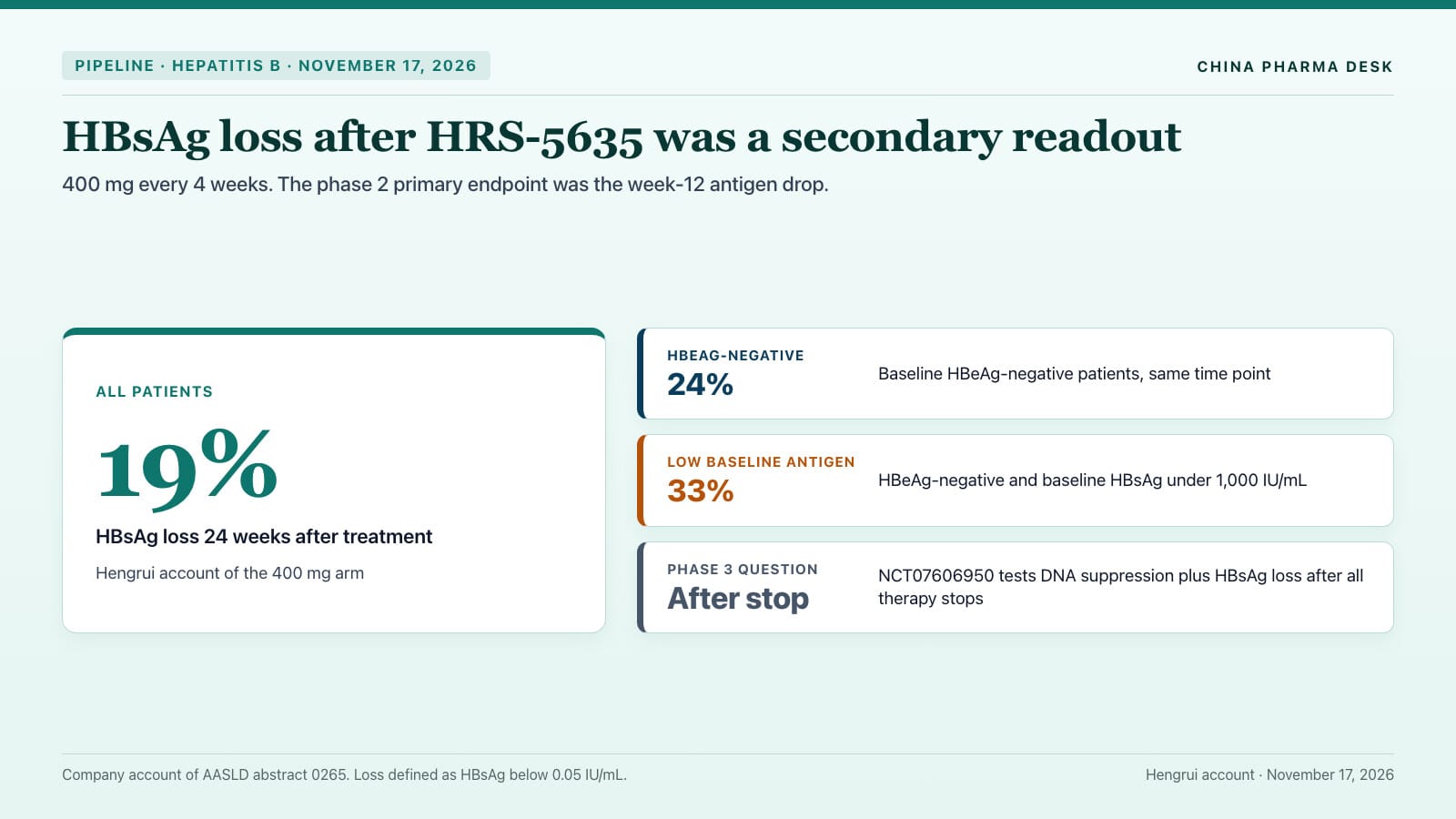
Jiangsu Hengrui Pharmaceuticals (SSE: 600276; HKEX: 01276) said on November 17, 2026 that a 48-week course of HRS-5635 at 400 mg every four weeks cleared hepatitis B surface antigen in 19% of patients 24 weeks after treatment stopped, and in 24% of those who were HBeAg-negative at baseline. The account describes an oral presentation at the American Association for the Study of Liver Diseases meeting in Denver on November 5–9, 2026, abstract 0265, from the phase 2 study NCT06425341. Clearance was not the primary endpoint of that part of the trial. The phase 3 already under way, NCT07606950, asks whether antigen loss and viral suppression hold for 24 weeks after all hepatitis B therapy stops.
HRS-5635 is Hengrui’s GalNAc-conjugated hepatitis B siRNA. Fujian Shengdi Pharmaceutical, the Hengrui subsidiary named as sponsor, is running both the phase 2 and the phase 3. This readout is separate from Hengrui’s approval of the ANGPTL3 antibody SHR-1918, covered here.
The phase 2 record is a randomized, open-label study in adults with chronic hepatitis B who are already virologically suppressed on a nucleos(t)ide analogue. Hengrui’s meeting account says Part A enrolled patients with HBsAg between 100 and 3,000 IU/mL and assigned them 1:2:2:2 to 50 mg or 200 mg or 400 mg every four weeks, or 100 mg weekly, each by subcutaneous injection for 48 weeks, with 24 weeks of follow-up. On ClinicalTrials.gov, the Part A primary endpoint is the change in mean log10 serum HBsAg at week 12. Antigen loss, seroconversion and the share of patients who meet criteria to stop nucleos(t)ide therapy are secondary.
In the 400 mg every-four-weeks arm, Hengrui reports a mean HBsAg decline of 2.63 log10 IU/mL (SD 0.70) at week 48 and 2.38 (SD 1.06) at 24 weeks after treatment. It defines HBsAg loss as a level below 0.05 IU/mL, and reports loss in 16% of that arm at week 48 and 19% at 24 weeks after treatment. Within that arm, the same account gives 24% loss among patients who were HBeAg-negative at baseline, and 33% among the HBeAg-negative patients whose baseline HBsAg was under 1,000 IU/mL. It also says the functional-cure rate in that low-antigen, HBeAg-negative subgroup was 20%, using its definition of DNA below the limit of quantitation plus HBsAg below 0.05 IU/mL for at least 24 weeks after a finite course, with or without seroconversion.
MedSci’s reading of abstract 0265 supplies the counts behind those rates: 5 of 32 patients at week 48 and 6 of 32 at week 72 in the 400 mg arm; 5 of 21 HBeAg-negative patients; and 5 of 15 of those with baseline HBsAg under 1,000 IU/mL, with no losses among the HBeAg-negative patients at or above 1,000 IU/mL in that arm. Those fractions round to the company’s 16%, 19%, 24% and 33%. The same reading puts the week-12 mean log10 decline in the 400 mg arm at 2.1 (SD 0.8), against 1.3, 2.0 and 1.9 in the other three arms. It also says the abstract does not state how many patients had stopped the nucleos(t)ide analogue, which is the point Hengrui’s own functional-cure definition turns on. The 20% figure should be read as Hengrui’s description, not as a result that can be recalculated from the abstract summary in circulation.
Hengrui says treatment-emergent events were mostly grade 1 or 2, with no dose-dependent safety signal. It names upper-respiratory infection as the most common event and says injection-site reactions and ALT elevations were uncommon. MedSci’s abstract reading adds that no treatment-related adverse event led to discontinuation. Rates are not in the November 17 account.
ClinicalTrials.gov, checked November 18, 2026, still lists NCT06425341 as recruiting, with no results posted. The record was last updated on November 17, 2025. Its estimated primary completion date is August 30, 2026. Estimated enrollment is 369, across monotherapy and interferon-combination parts. The meeting data are a slice of Part A, not a registry result.
The phase 3 is already recruiting on a narrower question. NCT07606950 (sponsor protocol HRS-5635-301) is a randomized, double-blind, placebo-controlled study in HBeAg-negative patients who are virologically suppressed on nucleos(t)ide monotherapy. The public record estimates 540 participants. Screening, 60 weeks of blinded treatment, 12 weeks on the nucleos(t)ide analogue alone, and 24 weeks off treatment can run to about 100 weeks. The primary endpoint is the percentage with sustained HBV DNA suppression and HBsAg loss within 24 weeks after all hepatitis B therapy stops. The first patient was enrolled on July 17, 2026. Primary completion is estimated for June 2028. The record, updated November 12, 2026, lists one recruiting site, Nanfang Hospital, with Jinlin Hou as principal investigator. Hengrui says the 400 mg every-four-weeks regimen was selected for the pivotal study. The registry intervention line does not state the milligram dose. Patients with cirrhosis or hepatic decompensation are excluded.
On September 22, 2025, Hengrui said the Center for Drug Evaluation had posted HRS-5635 for proposed breakthrough-therapy designation in chronic hepatitis B. The November 17 account says the indication was included in that program in September 2025. Breakthrough-therapy designation in China is a review-communication channel during development. It is not an approval and it does not set a price.
The next records that would change this reading are a ClinicalTrials.gov results or status update for NCT06425341 that shows the week-12 declines and the antigen-loss counts, a protocol or listing amendment that states the phase 3 dose, and any table that says how many phase 2 patients had actually stopped nucleos(t)ide analogues before the 20% functional-cure figure is used.
Checked November 18, 2026 against Hengrui’s November 17 account of AASLD abstract 0265, MedSci’s reading of that abstract, ClinicalTrials.gov records NCT06425341 and NCT07606950, and Hengrui’s September 22, 2025 notice.