FDA rejects Summit and Akeso's ivonescimab on survival, exposing China's cross-border trial gap
U.S. FDA issued a Nov 15, 2026 Complete Response Letter to Summit (NASDAQ: SMMT) and Akeso (HKEX: 09926) for PD-1 x VEGF bispecific ivonescimab (AK112) over missed primary overall survival in HARMONi.
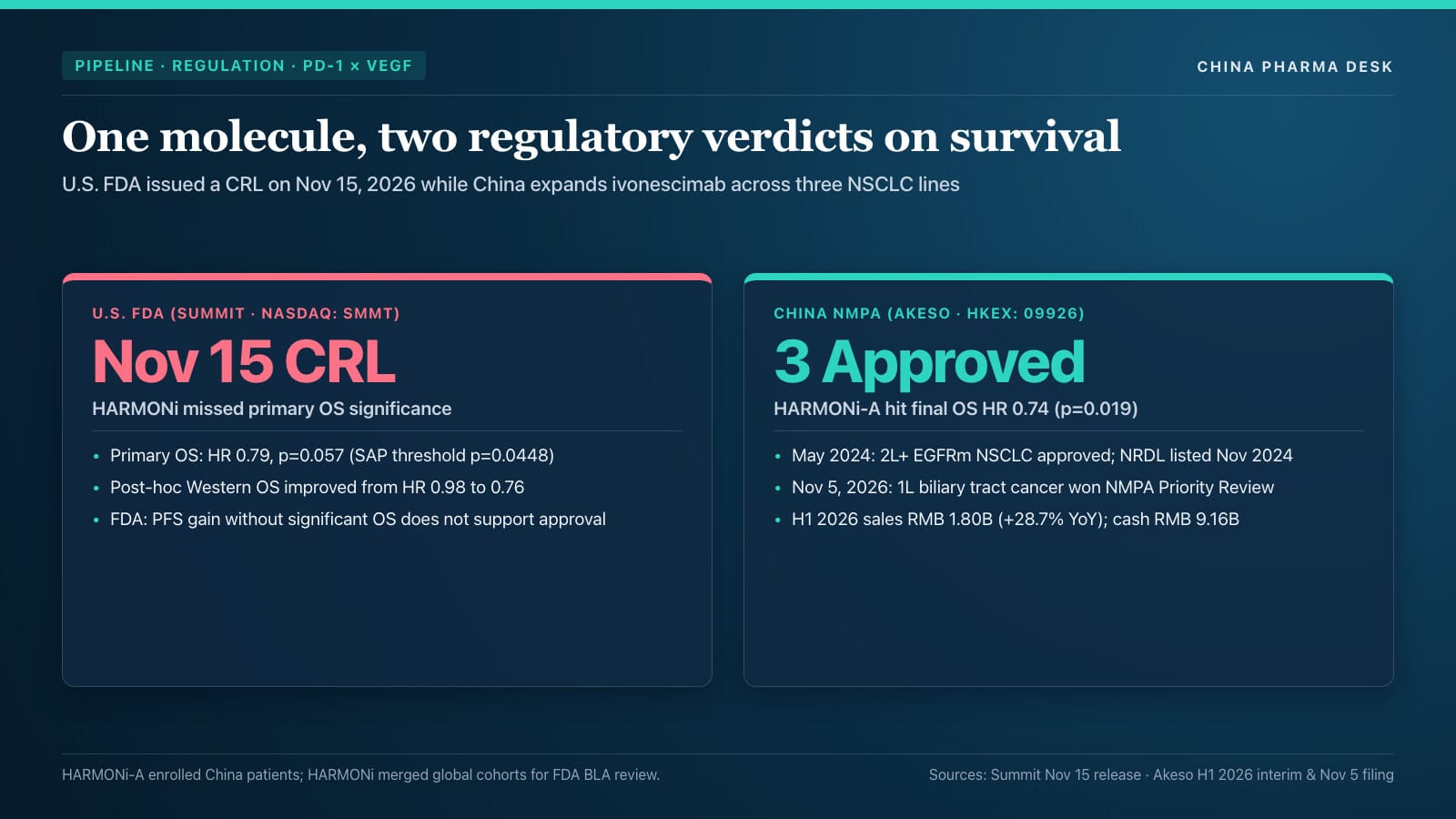
The U.S. Food and Drug Administration (FDA) issued a Complete Response Letter (CRL) on November 15, 2026, declining to approve Summit Therapeutics (NASDAQ: SMMT) and Akeso (HKEX: 09926) for PD-1 x VEGF bispecific antibody ivonescimab (AK112 / SMT112) plus platinum chemotherapy in second-line or later EGFR-mutated non-squamous non-small cell lung cancer (NSCLC). Regulators ruled that progression-free survival (PFS) gains in the global Phase III HARMONi trial do not establish a positive benefit-risk profile without a statistically significant overall survival (OS) improvement, leaving ivonescimab’s first U.S. launch stalled even as Akeso holds three approved NSCLC indications in China and won Chinese priority review for first-line biliary tract cancer ten days earlier.
For global biopharma dealmakers, the divergence is the story. Ivonescimab was China biotech’s flagship validation case—out-licensed to Summit in late 2022 in a deal valued at up to $5 billion—and the pace-setter for an entire wave of Chinese-originated PD-(L)1 x VEGF bispecifics. The CRL shows that replicating Chinese survival curves through post-hoc follow-up on an underpowered Western bridge will not satisfy FDA oncology reviewers when primary statistical gates are missed.
The China Delta: identical setting, opposite verdicts
The regulatory split occurred in the exact same clinical niche: patients with EGFR-mutated non-squamous NSCLC progressing after third-generation EGFR tyrosine kinase inhibitors. China’s National Medical Products Administration (NMPA) approved ivonescimab (branded as Yidafang in China) in May 2024 based on the China-only Phase III HARMONi-A (AK112-301) trial and added it to China’s National Reimbursement Drug List (NRDL) in November 2024. At the final HARMONi-A OS analysis presented at SITC 2025 (median follow-up 32.5 months, subsequently published in JAMA in June 2026), ivonescimab plus chemotherapy achieved statistically significant gains on both endpoints: PFS hazard ratio (HR) 0.46 (p < 0.001) and median OS of 16.8 months versus 14.1 months for chemotherapy alone (HR 0.74, p = 0.019).
By contrast, the global HARMONi dossier—which merged China HARMONi-A data with Western enrollment to support the U.S. biologics license application—stumbled on trial maturity and alpha allocation. At the primary OS analysis, Akeso disclosed an OS HR of 0.79 (95% CI: 0.62–1.01; p = 0.057), missing the statistical analysis plan’s p = 0.0448 significance boundary. Because median follow-up for Western patients stood at just 9.2 months at that cutoff, the Western subgroup initially showed an OS HR of 0.98. Extended follow-up to September 2025 (13.7 months median Western follow-up) brought full-trial OS to HR 0.78 (nominal p = 0.0332) and Western OS to HR 0.84 (North American HR 0.70), and Akeso’s interim report reported that a July 2026 update reached HR 0.76 across both the overall population and Western patients.
The FDA did not budge. In its November 15 statement, Summit acknowledged that the agency found substantial evidence of effectiveness lacking because the primary OS endpoint missed statistical significance—and Summit had already parted ways with its chief commercial officer and senior marketing leadership ahead of the decision, according to Fierce Biotech.
| Trial / Jurisdiction | Setting & Comparator | PFS Result | OS Result & Statistical Gate | Regulatory Status (Nov 15, 2026) |
|---|---|---|---|---|
HARMONi-A (China Phase III, AK112-301) |
2L+ EGFRm non-sq NSCLC vs. chemo | HR 0.46 (p < 0.001) | mOS 16.8 vs. 14.1 mo; HR 0.74, p = 0.019 (met SAP) | NMPA approved May 2024; NRDL Nov 2024 |
| HARMONi (Global Phase III BLA) | 2L+ EGFRm non-sq NSCLC vs. chemo | Statistically significant (48% risk cut) | Primary: HR 0.79, p = 0.057 (missed p = 0.0448); post-hoc Jul 2026 HR 0.76 | FDA CRL issued Nov 15, 2026 |
HARMONi-2 (China Phase III, AK112-303) |
1L PD-L1+ NSCLC vs. pembrolizumab | mPFS 11.14 mo, HR 0.51 | Interim OS met statistical significance (Sep 3, 2026 filing) | NMPA approved Apr 2025; NRDL-covered |
HARMONi-6 (China Phase III, AK112-306) |
1L squamous NSCLC vs. tislelizumab + chemo | mPFS 11.14 vs. 6.9 mo; HR 0.60 (p < 0.0001) | Dual positive PFS and OS reported | NMPA approved Aug 2026 |
HARMONi-GI1 (China Phase III, AK112-309) |
1L biliary tract cancer vs. durvalumab + chemo | Secondary endpoints met | mOS 14.9 vs. 12.1 mo; HR 0.75, p = 0.0031 (ESMO Oct 2026) | NMPA Priority Review granted Nov 5, 2026 |
Safety was not cited as the blocker in HARMONi: discontinuation due to treatment-related adverse events was 7.3% (16 patients) for ivonescimab plus chemotherapy versus 5.0% (11 patients) for placebo plus chemotherapy, with treatment-related deaths at 1.8% (4 patients) versus 2.3% (5 patients).
Akeso’s domestic cushion vs. Summit’s commercial reset
For Akeso, the CRL delays overseas royalty and regulatory-milestone upside but does not destabilize near-term operations. In its 2026 interim report (for the six months ended June 30, 2026), Akeso posted RMB 1,803.2 million (approx. $250 million) in net commercial drug sales, up 28.7% year-on-year, while narrowing its half-year loss to RMB 447.2 million (approx. $62 million) and holding RMB 9,160.0 million (approx. $1.27 billion) in cash, cash equivalents, time deposits, and short-term financial products. All 12 approved indications across five marketed Akeso biologics had entered China’s NRDL by year-end 2025, ahead of the August 2026 approval in first-line squamous NSCLC.
That financial buffer reflects a deliberate vertical-integration bet. In a live interview with Weijieyao, Akeso founder and chairwoman Xia Yu noted that the company built internal R&D, process development, and manufacturing across its bases from inception, allowing its first ten internally initiated programs to advance without clinical failure and positioning ivonescimab for a U.S. BLA filing within two years of licensing without prior U.S. patient data (translated from Mandarin). The November 15 CRL shows the precise limit of that accelerated strategy: bridging onto mature Chinese data saved years on filing speed, yet left the global study exposed to immature Western follow-up when FDA required pre-specified OS confirmation.
Summit, by contrast, must carry the broader global program—supported by AstraZeneca’s $2 billion strategic equity investment (approx. 12% stake) announced in September 2026 and cooperative-group trials including ECOG-ACRIN EA2251 in biliary tract cancer and GORTEC ILLUMINE (NCT07264075) in head-and-neck cancer—until multiregional first-line trials mature.
Resetting the PD-(L)1 x VEGF and EGFR-resistant NSCLC race
The U.S. delay narrows ivonescimab’s lead over five well-capitalized rivals racing to establish PD-(L)1 x VEGF bispecifics in Western registrations:
- 3SBio (HKEX: 01530) / Pfizer:
tivunatamig(SSGJ-707/PF-08634404), licensed ex-China in a 2025 deal carrying $1.25 billion upfront and up to $4.8 billion in milestones (plus $150 million China option and $100 million equity), is enrolling both the 1,410-patient global Phase IIISymbiotic-Lung-01(NCT07222566) and China Phase IIINCT06980272against pembrolizumab. - BioNTech / Bristol Myers Squibb:
pumitamig(BNT327), acquired via BioNTech’s Biotheus buyout and co-developed with BMS, is running global Phase III studies in lung cancer (NCT07111520combines it with BioNTech/DualityBio ADCBNT326). - RemeGen (HKEX: 09995; SSE: 688331) / AbbVie:
RC148(ABBV-1480) has entered Phase III development in China—including a newly posted November 13 Phase II/III gastric study (NCT07935369) paired with CLDN18.2 ADCRC118—alongside AbbVie’s ex-Greater China license. - Merck & Co. (
MK-2010/LM-299) and Junshi Biosciences (HKEX: 01877; SSE: 688180,JS207): LaNova-originatedMK-2010is advancing in early global cohorts, while unpartneredJS207holds an FDA-cleared Phase II/III neoadjuvant NSCLC IND and launched a Phase III first-line liver cancer trial (NCT07823348).
In second-line EGFR-mutated NSCLC specifically, ivonescimab’s U.S. absence leaves the field open to TROP2 and bispecific ADCs already reading out or enrolling multiregional Phase III trials—notably AstraZeneca and Daiichi Sankyo’s Datroway, Merck and Kelun-Biotech’s (HKEX: 06990) sac-TMT, and Bristol Myers Squibb and Baili-Bio (SSE: 688506) EGFR x HER3 bispecific ADC izalontamab brengitecan (iza-bren / BL-B01D1, IZABRIGHT-Lung01, NCT07100080), which also entered China’s 2026 NRDL on November 14.
Next evidence triggers
Three near-term readouts will determine whether HARMONi is an isolated statistical miss or a broader drag on Summit and Akeso’s global timeline:
- Year-end 2026 squamous PFS readout in
HARMONi-3: Summit flagged that the squamous first-line NSCLC cohort—which missed statistical significance at an April 2026 interim look—moves to final PFS analysis by late 2026, while the non-squamous cohort runs separately. - Global Phase III
HARMONi-7(1L PD-L1-high NSCLC vs. pembrolizumab) andHARMONi-GI3(NCT07228832, 1L mCRC) enrollment and OS powering disclosures, where multiregional patient proportions and formal alpha spending on OS will face heightened FDA scrutiny. - China NMPA approval decision on
HARMONi-GI1(AK112-309) in first-line biliary tract cancer following the November 5 priority review grant, testing whether Akeso can expand domestic commercial volume past its NSCLC base while U.S. regulators await multiregional OS proof.