J&J to buy Ollin for $2.2 billion upfront, adding Innovent-origin IBI324
J&J (NYSE: JNJ) agreed on Nov 16, 2026 to buy Ollin for $2.2 billion upfront, adding Innovent Biologics' (HKEX: 01801) IBI324/OLN324; Innovent's proceeds remain unquantified.
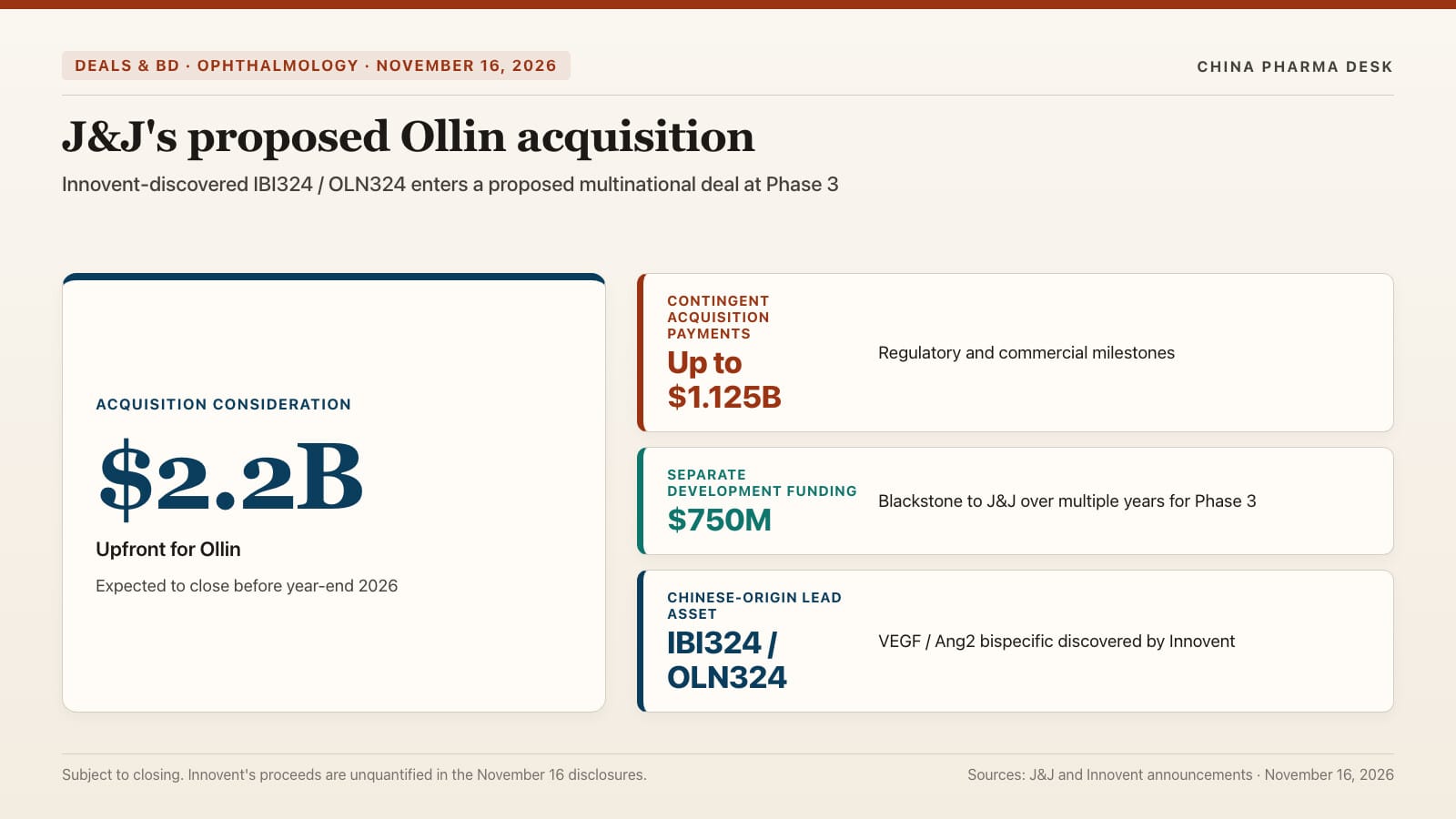
Johnson & Johnson (NYSE: JNJ) agreed on November 16, 2026 to acquire Austin-based Ollin Biosciences for $2.2 billion upfront, bringing the Innovent Biologics (HKEX: 01801)-discovered VEGF/Ang2 bispecific antibody IBI324, also called OLN324, into its planned ophthalmology pipeline. J&J’s announcement and Innovent’s same-day Hong Kong filing confirm the transaction and the asset’s Chinese origin. Closing is expected before year-end, subject to regulatory approvals and customary conditions; the disclosures do not quantify Innovent’s proceeds.
The deal gives a Chinese-discovered retinal drug a proposed multinational owner as it enters pivotal development. The two questions for China-focused dealmakers are how the acquisition value reaches the originator, and what evidence supports OLN324’s differentiation from established retinal therapies.
Three money flows, with different purposes
J&J disclosed up to approximately $1.125 billion in regulatory and commercial milestones on top of the upfront consideration. The maximum acquisition consideration therefore reaches approximately $3.325 billion, with a substantial portion conditional on future events.
A separate agreement would bring Blackstone Life Sciences into the program’s development economics:
| Amount | Payment or commitment | Economic purpose |
|---|---|---|
| $2.2 billion upfront | J&J’s consideration to acquire Ollin | Acquisition, subject to closing |
| Up to approximately $1.125 billion | Additional regulatory and commercial milestones | Contingent acquisition consideration |
| $750 million over multiple years | Blackstone funding paid to J&J | Full funding of OLN324 Phase 3 development; Blackstone becomes eligible for specified regulatory and sales milestones and single-digit royalties |
The Blackstone arrangement is contingent on acquisition closing. It supplies development capital to J&J, while creating a separate set of potential future payments linked to the program.
Innovent sits upstream of this structure. Its November 16 filing says it discovered IBI324 and out-licensed it to Ollin. In its June financing announcement, Innovent also described itself as an investor in Ollin, which had raised a $330 million Series B. Neither that release nor the takeover filings reviewed here specify Innovent’s ownership percentage or the license terms needed to calculate its share of the transaction.
The transaction values Ollin as a company around its lead program; Innovent’s realized return remains unquantified. It extends the range of financing routes for Chinese-origin assets: alongside the Windward Bio public-market example, Ollin now offers an announced trade sale before pivotal results.
The early benchmark was faricimab
OLN324’s clinical case rests on the randomized, U.S.-based Phase 1b JADE study, NCT07484074, which enrolled 164 patients with diabetic macular edema (DME) or wet age-related macular degeneration (wAMD). Participants received three monthly doses of OLN324 at 2 mg or 4 mg, or faricimab at 6 mg, followed by an off-treatment period with protocol-defined retreatment.
In its March 30 final-data release, Ollin reported that 93% of DME patients receiving OLN324 4 mg reached the end of the 12-week follow-up without retreatment, versus 89% on faricimab. In wAMD, the corresponding figures were 82% and 81%, with a numerical 2.2-letter visual-acuity advantage for OLN324 4 mg at Week 20. The company reported no intraocular inflammation with OLN324, versus one case with faricimab, and no retinal vasculitis with OLN324.
Those findings explain the interest in drying, vision and durability, but the measures are not interchangeable. JADE’s primary objective was safety and tolerability; efficacy comparisons were exploratory. The DME retreatment separation was larger than the wAMD separation, and the numerical vision difference does not establish a pivotal superiority result.
Phase 3 changes the comparison
The registered pivotal program tests visual acuity over longer periods against aflibercept or ranibizumab:
| Trial and registry identifier | Population and planned enrollment | Active comparator | Primary visual-acuity assessment |
|---|---|---|---|
| ATACAMA, NCT07841899 | DME; 450 | Aflibercept | Change in BCVA at Week 48 |
| GOBI, NCT07842016 | DME; 450 | Aflibercept | Change in BCVA at Week 48 |
| MOJAVE, NCT07816315 | wAMD; 500 | Aflibercept | Change in BCVA at Week 48 |
| SAHARA, NCT07816289 | wAMD; 400 | Monthly ranibizumab | Change in BCVA at Week 36 |
These four studies plan approximately 1,800 participants in total. Their registry entries, last updated in September, still displayed “not yet recruiting” when checked on November 16; Innovent’s newer November 16 filing says global Phase 3 recruitment has begun. The designs above come from the registry, while the recruitment update comes from Innovent.
The distinction matters for valuation: JADE supplied an early faricimab benchmark, whereas the pivotal program is set up to establish performance against different active controls. Its results will answer a different comparison from the one that generated the initial clinical interest.
The immediate evidence trigger is the closing announcement, expected before the end of 2026, together with any disclosure that allows Innovent’s economic participation to be calculated. The clinical trigger is the Phase 3 visual-acuity dataset; the current registry estimates primary completion in December 2028 for all four studies.