Tong Ren Tang revives Tianjin acquisition: the price of buying hospital access
Beijing Tong Ren Tang (SSE: 600085) proposes RMB 2.4438 billion for 60% of Tianjin Tongrentang in Announcement 2026-036, reviving a deferred parent-to-listed-company transfer.
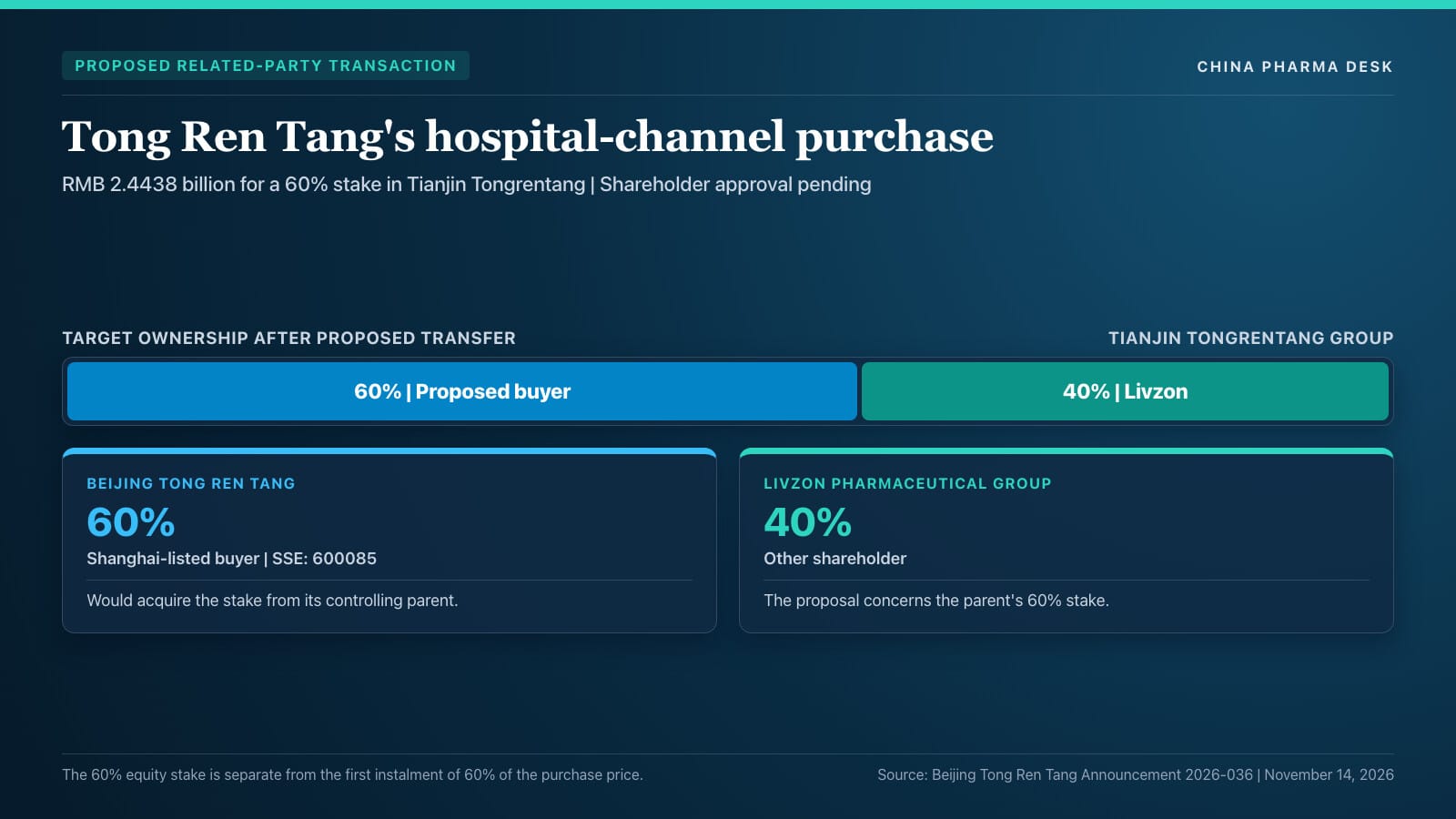
Beijing Tong Ren Tang Co., Ltd. (SSE: 600085) proposes buying 60% of Tianjin Tongrentang Group for RMB 2.4438 billion (approximately $364 million) from its controlling parent, according to Announcement 2026-036, dated November 14. The board approved the proposal on November 12; shareholder approval remains outstanding. The transaction would move a business already controlled by the parent into the Shanghai-listed company, giving the listed buyer a larger hospital-facing product portfolio.
The dollar reference uses the November 13 central parity rate of RMB 6.7152 per dollar. The contract consideration is denominated in renminbi.
A postponed transfer returns under different operating conditions
The seller is China Beijing Tong Ren Tang Group, which owns 52.45% of the listed buyer. It holds the 60% target stake being transferred; Livzon Pharmaceutical Group holds the other 40%. Keeping these entities separate matters: the purchaser is SSE: 600085, and the target is Tianjin Tongrentang Group.
There is a revealing earlier decision. In Announcement 2025-002, dated January 7, 2025, the listed company said an acquisition was inappropriate at that point because of integration risk and the industry’s 2024 downturn. The parent had acquired the Tianjin stake in December 2024.
The transaction also sits inside an older governance commitment. An E-Yao Manager sector review published January 2, 2025 placed the Tong Ren Tang transaction within a wider wave of state-backed consolidation in traditional Chinese medicine. The corporate boundary is crucial to applying that history: the parent had bought control, while the listed company had deferred an acquisition.
Announcement 2025-002 also set out the parent’s commitment to resolve the relevant competing-business issues within five years. It listed several possible routes, including equity or asset transfers, entrusted management, changes to product structures and cessation of relevant operations. The commitment did not require an immediate cash purchase by the listed company. The present equity-transfer proposal uses one of those routes and, according to the new filing, would resolve the remaining overlap.
That history changes the investment question. Bringing the asset into the listed company would address an existing group-governance issue as well as add a hospital portfolio. Those benefits still have to justify the cash paid by the listed buyer; a group-level rationale alone does not establish the return available to its minority shareholders.
The new filing shows a subsequent recovery in the target’s reported results. Revenue rose from RMB 985.9 million in 2024 to RMB 1.0375 billion in 2025, an increase of about 5.2%. Net profit rose from RMB 168.4 million to RMB 199.5 million, about 18.5%. First-half 2026 revenue was RMB 563.3 million and net profit RMB 129.8 million.
Those figures improve the operating basis for revisiting the purchase. They do not establish the value of future integration benefits. In particular, the latest half-year should not simply be doubled into a full-year earnings forecast.
The channel rationale is concrete; the synergy remains to be earned
The buyer says the target’s core products, including Shenyankangfu Tablets, Xuefuzhuyu Capsules and Maiguan Fukang Tablets, sell predominantly through public medical institutions. Tianjin Tongrentang brings hospital academic-promotion and account resources. The listed buyer describes its own distribution strengths as centred on retail, including major products such as Angong Niuhuang Pills.
The industrial logic is therefore broader access to a different set of customers. A hospital-facing portfolio could diversify a retail-heavy business, while the buyer’s retail relationships could provide a second route for suitable target products.
This is the company’s rationale, rather than evidence that cross-selling has already occurred. Different prescribing settings, product indications and commercial teams can make channel combination slower than ownership consolidation. A useful post-closing test will be whether the acquired portfolio produces sustained sales and cash generation without a disproportionate increase in selling expenditure.
The valuation demands more than a recovery narrative
The price is based on a RMB 4.073 billion valuation of all target equity as of June 30, 2026, using the market approach. The filing reports a 339.29% uplift over consolidated equity attributable to the target’s parent shareholders at that date, equivalent to roughly 4.39 times that book value.
That percentage is a comparison with accounting equity. It is not a premium to a quoted share price and should not be presented as a takeover premium for public shareholders. The buyer also says the stake price does not exceed the parent’s purchase price and provides no transfer-price gain to the parent.
The two observations address different questions. Passing the stake on without a parent-level transfer gain does not by itself establish an attractive return for the listed buyer. At a value materially above book, the investment case rests on the durability of the target’s earnings and the additional commercial results available under listed-company ownership. The filing specifies no performance-linked earn-out.
Affordable at group level, material to cash deployment
The buyer’s third-quarter 2026 report records consolidated monetary funds of RMB 9.7523 billion at September 30. The purchase price is about 25.1% of that balance. This is a scale comparison, not a claim that all consolidated cash is unrestricted or immediately available to the parent company.
The operating backdrop is also relevant: the same report shows nine-month revenue down 16.90% and net profit attributable to listed-company shareholders down 26.48% year on year. The acquisition would add another earnings base during a difficult period for the buyer, but it would also commit capital while the existing business is under pressure.
Payment is staged. The first instalment is 60% of the consideration, RMB 1.46628 billion, due within five working days after the agreement becomes effective. The remaining RMB 977.52 million is due by March 31, 2027, with interest linked to an agreed loan-prime-rate reference and a seller-approved guarantee.
The identical 60% figures describe different things: one is the equity stake; the other is the first instalment’s share of the purchase price. Staging reduces the immediate cash outflow, while the interest and guarantee requirements attach a cost and a condition to the deferral.
The next decision is the shareholder vote, from which the related parent will abstain. After approval and contractual effectiveness, the first payment and ownership registration will show whether the proposed channel acquisition has become an operating subsidiary of the listed company.
Updated November 14, 2026: Added the prior competing-business commitment and its implications for the proposed transfer.