Windward Bio's $225 million Nasdaq debut tests China's equity-linked respiratory NewCo model
Windward Bio (NASDAQ: WWB) priced a $175 million IPO and $50 million Sanofi placement on Nov 12, 2026, putting Kelun-Biotech (06990.HK), Harbour BioMed (02142.HK), and Qyuns (02509.HK) assets in public hands.
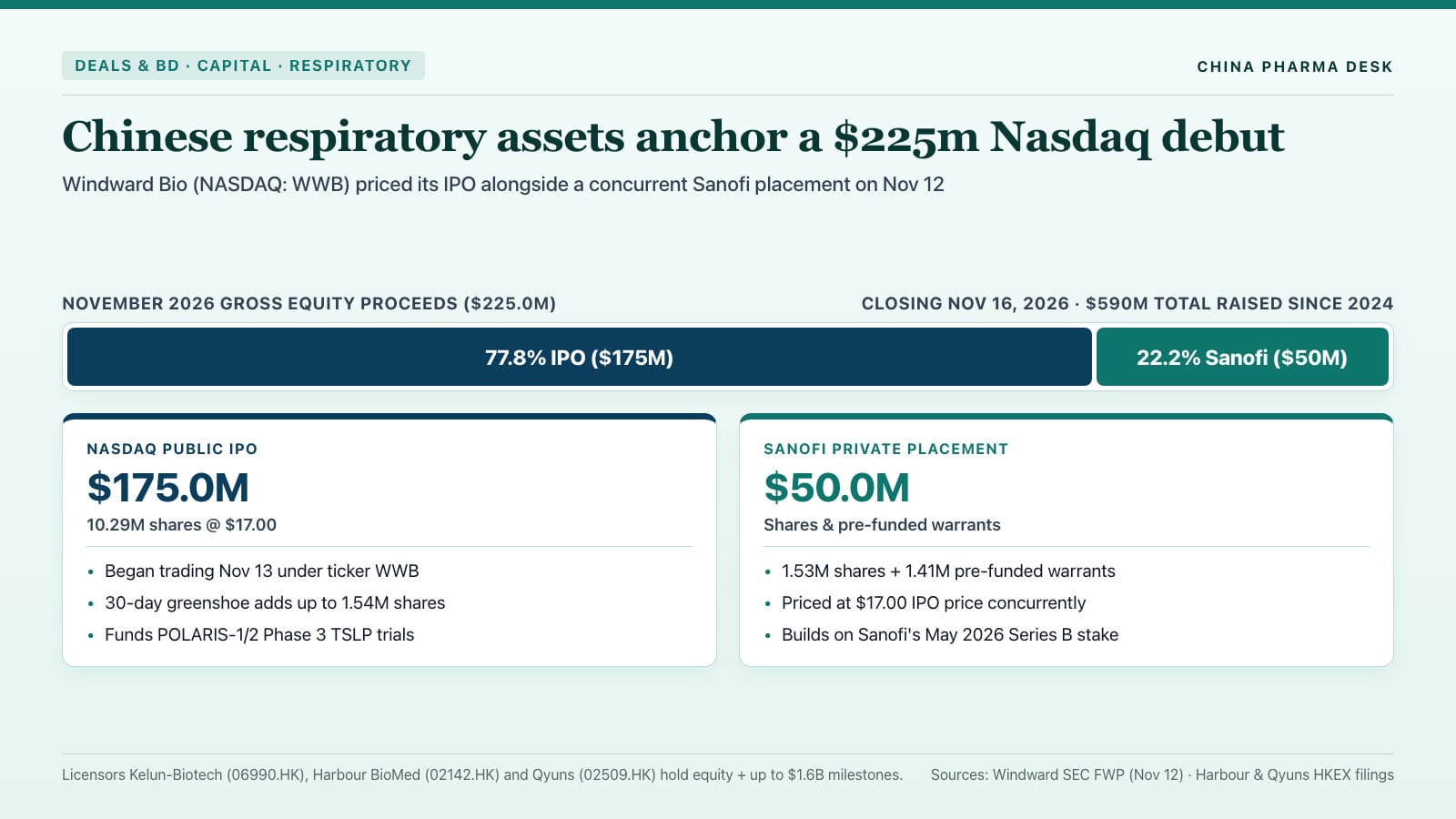
Basel-based Windward Bio Group AG (NASDAQ: WWB) priced its $175 million U.S. initial public offering and a concurrent $50 million Sanofi private placement on November 12, 2026, beginning Nasdaq trading on November 13 ahead of a scheduled November 16 closing. Rather than internal discovery, Windward’s entire clinical pipeline rests on two ultra-long-acting respiratory antibodies in-licensed from Chinese biotechs—putting equity stakes and up to $1.6 billion in downstream milestones held by Harbour BioMed (HKEX: 02142), Sichuan Kelun-Biotech (HKEX: 06990), and Qyuns Therapeutics (HKEX: 02509) directly onto U.S. public markets.
The listing tests the second act of China’s “NewCo” out-licensing wave: taking small cash-plus-equity upfronts to let an offshore, venture-backed vehicle fund expensive Phase III respiratory trials, while Chinese originators retain Greater China commercial rights and ride any U.S. public-market re-rating.
$225 million financing and the Chinese asset stack
Under its November 12 SEC free writing prospectus (relating to Form F-1 File No. 333-299608), Windward sold 10,294,117 common shares at $17.00—the midpoint of its $16–$18 range—for $175.0 million in gross IPO proceeds (excluding a 30-day underwriters’ option for 1,544,117 shares), alongside Sanofi Foreign Participations B.V.’s concurrent $50.0 million purchase of 1,532,691 shares and 1,408,485 pre-funded warrants at the same price. Estimated net proceeds stand at $203.8 million, lifting Windward’s cumulative equity raised since its 2024 founding to approximately $590 million (following a $200 million Series A in January 2025 and a $165 million Series B in May 2026).
Across its two licensing pacts, Windward committed $70 million in combined upfront cash and equity plus roughly $1.6 billion in potential milestones:
| Asset (China Code) | Chinese Originator(s) | Deal Terms & Equity Structure | Clinical Status & Benchmark |
|---|---|---|---|
WIN378 (HBM9378 / SKB378, anti-TSLP mAb) |
Harbour BioMed (02142.HK) & Kelun-Biotech (06990.HK, 50/50 split) |
Up to $970 million upfront + milestones (incl. $45 million cash/equity upfront & near-term fees) + tiered royalties; licensors keep Greater China & parts of SE/West Asia | Seamless Phase II/III POLARIS-1 (NCT07120503, n=147 in Ph2) chose twice-yearly dosing for Ph3 severe asthma; Ph2 COPD SIRIUS (NCT07646587) ongoing |
WIN027 (QX027N, TSLP x IL-13 bispecific) |
Qyuns Therapeutics (02509.HK) |
Up to $700 million total (undisclosed cash upfront + Windward equity + milestones) + tiered royalties; Qyuns keeps Greater China (QX027N) |
Global Phase I showed 62-day half-life; global Ph2b COPD & Ph2 AD start H1 2027; Qyuns started China Ph2 AD & CRSwNP in Sep 2026 |
For the Chinese originators, equity-linked licensing has already reshaped near-term income statements without resolving long-term valuation capture. In its H1 2026 interim filing, Qyuns reported RMB 424.1 million (approx. $58.9 million) in revenue—up 105.4% year-on-year—and swung to a RMB 203 million (approx. $28.2 million) interim profit, driven primarily by RMB 378.6 million in licensing revenue that included upfront cash and non-cash Windward equity for QX027N (alongside Roche and Joincare deals). Harbour and Kelun-Biotech likewise hold equity stakes in Windward’s parent plus change-of-control and sublicense participation clauses, though Windward controls ex-China clinical execution and capital allocation.
Twice-yearly TSLP into a crowded respiratory arena
Clinically, Windward’s pitch rests on dosing convenience against Amgen and AstraZeneca’s approved anti-TSLP blockbuster Tezspire (tezepelumab, FDA BLA761224), which is dosed every four weeks and generated roughly $2 billion in annual sales. At the September 2026 interim readout from the 147-patient Phase II dose-finding portion of POLARIS-1 (n=98 analyzed), WIN378 improved lung function and airway inflammation biomarkers enough to advance two twice-yearly regimens into the Phase III asthma portion, with a second Phase III study (POLARIS-2) slated for H1 2027.
Yet the long-acting TSLP niche already carries an expensive Chinese precedent: in 2024, GSK paid $1 billion upfront to acquire Aiolos Bio, whose long-acting anti-TSLP candidate AIO-001 (SHR-1905) originated at Jiangsu Hengrui Pharmaceuticals (SSE: 600276; HKEX: 01276). Meanwhile, Qyuns itself runs a parallel domestic TSLP program, QX008N (JKN2401), licensed to Joincare in China and in a Phase III COPD study since March 2026.
Next evidence triggers
- Closing and initial public float performance of Windward’s $225 million offering on November 16, 2026, plus any 30-day greenshoe exercise and disclosures on Harbour, Kelun-Biotech, and Qyuns post-IPO equity stakes in subsequent HKEX filings.
- First half of 2027 clinical catalysts:
POLARIS-2Phase III asthma initiation and full Phase IIPOLARIS-1presentation forWIN378, plus full Phase I PK/immunogenicity data and global Phase IIb COPD / Phase II AD enrollment starts forWIN027(QX027N). - December 2027 primary completion of
SIRIUS(NCT07646587) in COPD and October 2028 primary completion ofPOLARIS-1(NCT07120503), which will test whether six-month dosing matches monthly TSLP efficacy on exacerbations.