China’s regulator wires the plumbing for BD trial handoffs and segmented ADC manufacturing—with two sharp catches
On Nov 13, 2026, China's NMPA and CDE issued Order No. 828 rules on 20-day clinical sponsor transfers, API holder transfers and segmented ADC manufacturing—adding single-NDA and inbound-only gates.
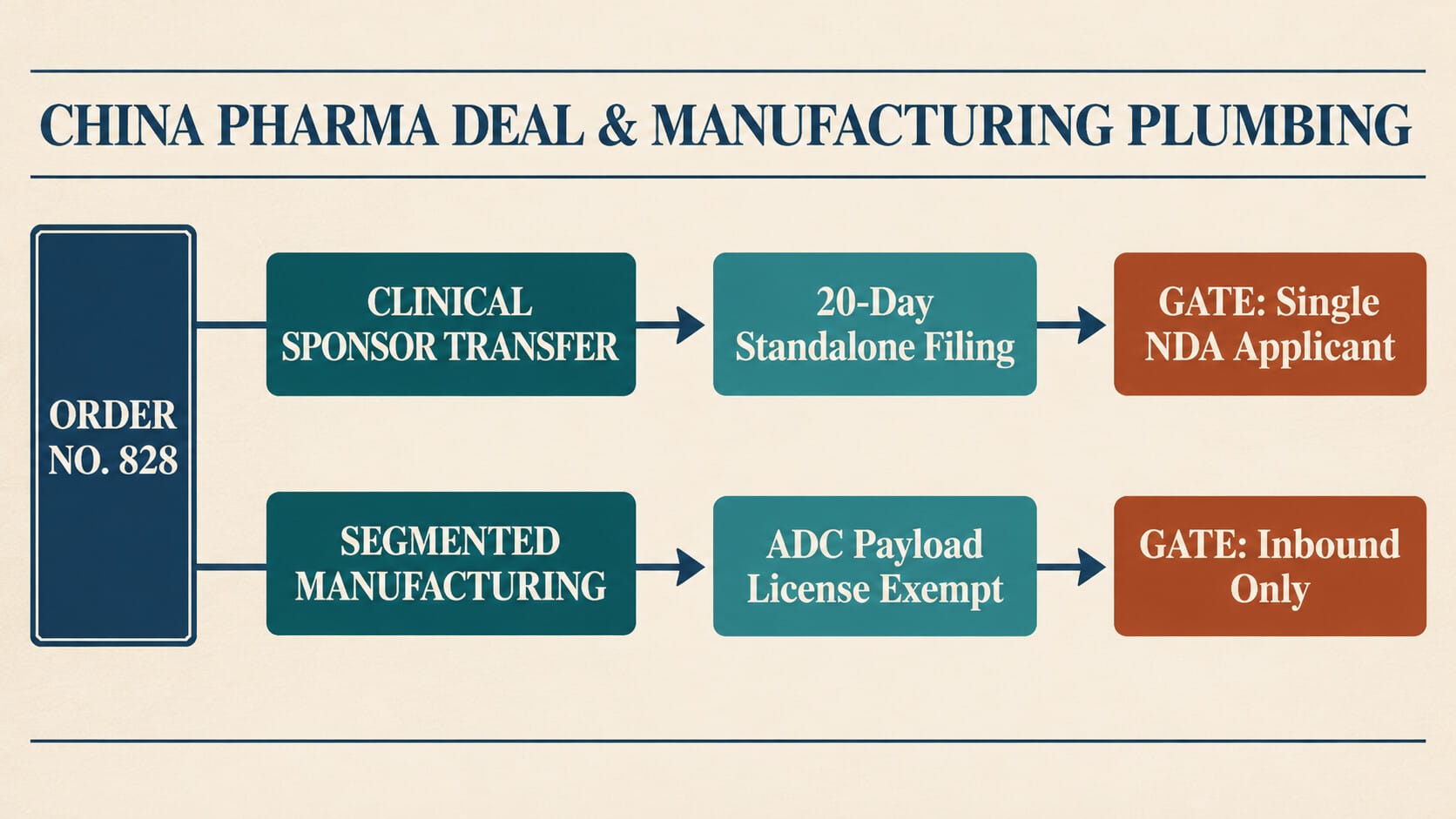
Six months after China’s overhauled Drug Administration Law Implementing Regulations (State Council Order No. 828) took effect on May 15, 2026, the National Medical Products Administration (NMPA) and its Center for Drug Evaluation (CDE) released a coordinated set of operational rules on November 13 governing how clinical trial sponsorships, chemical active pharmaceutical ingredient (API) certificates, and multi-site manufacturing stages can be split or transferred. Across CDE’s eight-point clinical sponsor-change Q&A draft, NMPA’s 23-clause contracted segmented manufacturing draft, and an evening NMPA executive-meeting decision adopting final API transfer and cell-and-gene-therapy (CGT) review rules, Beijing is removing longstanding procedural bottlenecks for biotech licensing and antibody-drug conjugate (ADC) supply chains—while inserting strict guardrails on split-indication NDA filings and outbound cross-border outsourcing.
Why November 13 matters: turning Order No. 828 into deal-closing mechanics
When State Council Order No. 828 took effect in May—the first comprehensive rewrite of China’s drug implementing regulations since 2002—it legalized standalone clinical-trial sponsor transfers under a 20-working-day statutory clock (Article 9), normalized segmented contract manufacturing (Article 33), and permitted transfers of chemical API approval certificates. Yet deal counsel and CMC teams spent the summer navigating gray zones because filing templates, multi-indication rules, and cross-border boundaries remained unwritten.
Together with CDE Notice No. 51 on bioequivalence trial filings issued a day earlier, November 13’s four-part regulatory push supplies that missing operational layer:
| Regulatory Instrument (Nov 13, 2026) | Issuing Body & Status | Core Operational Unlock | Structural Catch / Compliance Gate |
|---|---|---|---|
| Clinical Trial Sponsor-Change Q&A (8 Q&As) | CDE draft; 10-working-day comment window | Standalone supplemental filing by incoming sponsor (20-working-day Art. 9 clock); no foreign regulator letter needed for imported drugs (Q7) | Split-indication trap (Q4): Separate trial sponsors allowed in clinic, but one single applicant must file all NDAs for the same drug |
| Contracted Segmented Manufacturing Notice (23 clauses) | NMPA draft; comments due Nov 30, 2026 | Normalizes multi-site stage splitting; exempts ADC small-molecule linker-payload intermediates from standalone Drug Manufacturing Licenses (Clause 22) | One-way cross-border gate (Clause 17): Overseas MAHs can outsource stages into China, but domestic MAHs cannot outsource stages abroad (except onshore-transferring originators) |
| Chemical API Holder Transfer Rules | Adopted at Nov 13 NMPA executive meeting (“imminent release”) | Unlocks transfer of active (“A”-status) API certificates (20-working-day CDE review without site change per July 23 draft) | Transferee must self-manufacture, hold ≥3 validation batches, and obtain consent from registered innovative-API rights holders |
| CGT Review & Approval Optimization Notice | Adopted at Nov 13 NMPA executive meeting (“imminent release”) | Early registration-testing intervention, lifecycle CMC change pathways, and priority expert panels for cell & gene therapies | Tightens full-lifecycle traceability and post-approval risk monitoring |
Deal-making impact: cleaner cross-border handoffs, but a hard wall on split-indication NDAs
According to CDE’s accompanying drafting note—distilled from 35 industry-association questions debated at a July 2026 enterprise symposium—clinical sponsor transfers previously lacked an independent channel and often had to piggyback on 60-working-day technical supplemental filings.
CDE’s eight-question draft cleans up three frequent friction points in China licensing, NewCo spinouts, and terminated BD handbacks while planting one major deal-structuring constraint:
- Decoupling ownership transfers from CMC reviews (Q1 & Q8): The incoming sponsor files a standalone supplemental application that in principle must not be bundled with technical changes, preserving Order No. 828’s 20-working-day administrative review. Where a company files an NDA without having served as the IND sponsor, both entities sign a standardized statutory confirmation transferring all data and registration rights and barring the former IND sponsor from submitting any competing China NDA.
- Eliminating foreign regulatory permission letters (Q7): When an overseas-manufactured drug changes its clinical trial sponsor in China—common after global biotech M&A or regional license restructurings—CDE explicitly waives any requirement to submit a certificate from the foreign country’s drug regulator permitting the change (though notarized and authenticated corporate delegation or termination deeds remain mandatory under Q2, Q6, and Q8).
- The Question 4 split-indication landmine: Chinese biotechs increasingly carve up domestic rights by therapeutic area—for example, keeping oncology indications while licensing autoimmune or metabolic indications of the same molecule to a domestic commercial partner. Under Question 4, different sponsors may run separate indication trials (and file indication-specific sponsor transfers), but at the marketing authorization stage, “different indications of the same drug shall be submitted for registration by the same marketing authorization applicant.” Because China’s MAH system ties post-market pharmacovigilance and pharmacopoeia standards to a single holder per drug formulation, split-indication partners can no longer assume each licensee can hold its own independent NDA—forcing co-promotion, royalty, or post-approval MAH-transfer structures instead.
Segmented manufacturing: an ADC payload carve-out paired with asymmetric borders
Building on China’s October 2024 biologics pilot, NMPA’s 23-clause draft turns contracted segmented (stage-by-stage) manufacturing into a permanent national pathway—restricted to four categories (Clause 2): innovative drugs with specialized process or facility demands, urgent/reserve drugs and vaccines designated by ministries, multivalent or combined vaccines, and foreign-manufactured originator drugs already approved in China that are transferring part or all of their production onshore.
Three provisions directly reshape multinational localization and domestic ADC supply chains:
- ADC payload and linker-payload exemption (Clause 22): In a major practical concession to China’s booming ADC sector, facilities producing mature, physicochemically stable, quality-controllable “small-molecule and other special intermediates” critical to ADC efficacy—where those intermediates are not regulated as standalone drugs or APIs—do not need to obtain a Drug Manufacturing License. Instead, the facility must comply with GMP, pass inspection by the MAH’s provincial regulator, accept extended inspections, and be listed by address and process step directly on the MAH’s own Drug Manufacturing License.
- One-way cross-border outsourcing (Clauses 17 & 20): Overseas MAHs may outsource partial manufacturing stages (such as bulk drug substance or sterile fill-finish) to Chinese contract manufacturers, provided their designated Chinese domestic responsible agent (jingnei zerenren) assumes joint and several liability and conducts at least one full-system GMP audit every year covering overseas sites as well. Conversely, Chinese domestic MAHs are barred in principle from outsourcing segmented production stages to overseas factories, with the sole exception of foreign originator drugs undergoing onshore localization.
- Anti-shell MAH rules, two on-site engineers, and video capture (Clauses 5, 9, 10 & 21): Newly applying domestic segmented-manufacturing MAHs must have self-developed or participated throughout R&D (blocking passive financial shell holders). Sterile segmented runs require at least one party to hold three or more years of commercial manufacturing experience in the same sterile dosage form (or three years of R&D/production experience where exempted under 2025 Notice No. 134). During production campaigns, the MAH must station at least two GMP-qualified technical staff on-site at the CMO and maintain real-time automated equipment telemetry plus video recording across human-machine interaction steps.
Next evidence triggers before year-end
Public comments on CDE’s sponsor-change Q&A close 10 working days from November 13 (around November 27, 2026 via [email protected]), while NMPA’s segmented manufacturing draft remains open until November 30, 2026 ([email protected]). Watch next for the formal numbered texts of the Chemical API Holder Transfer Rules and CGT Review Optimization Notice cleared at Commissioner Huang Guo’s November 13 meeting—specifically whether the final API text preserves the July draft’s 20-working-day fast track for non-site-change corporate transfers and its consent veto for registered innovative-API rights holders.