Qilu registers a Phase 3 myeloma trial for its BCMA/GPRC5D trispecific—against triplets, not bispecifics
Qilu Pharmaceutical posted a 300-patient Phase 3 myeloma study (NCT07933432) for GPRC5D/BCMA/CD3 trispecific QLS4131 vs. DPd or PVd triplets, trailing J&J's ramantamig and Innovent's IBI3003.
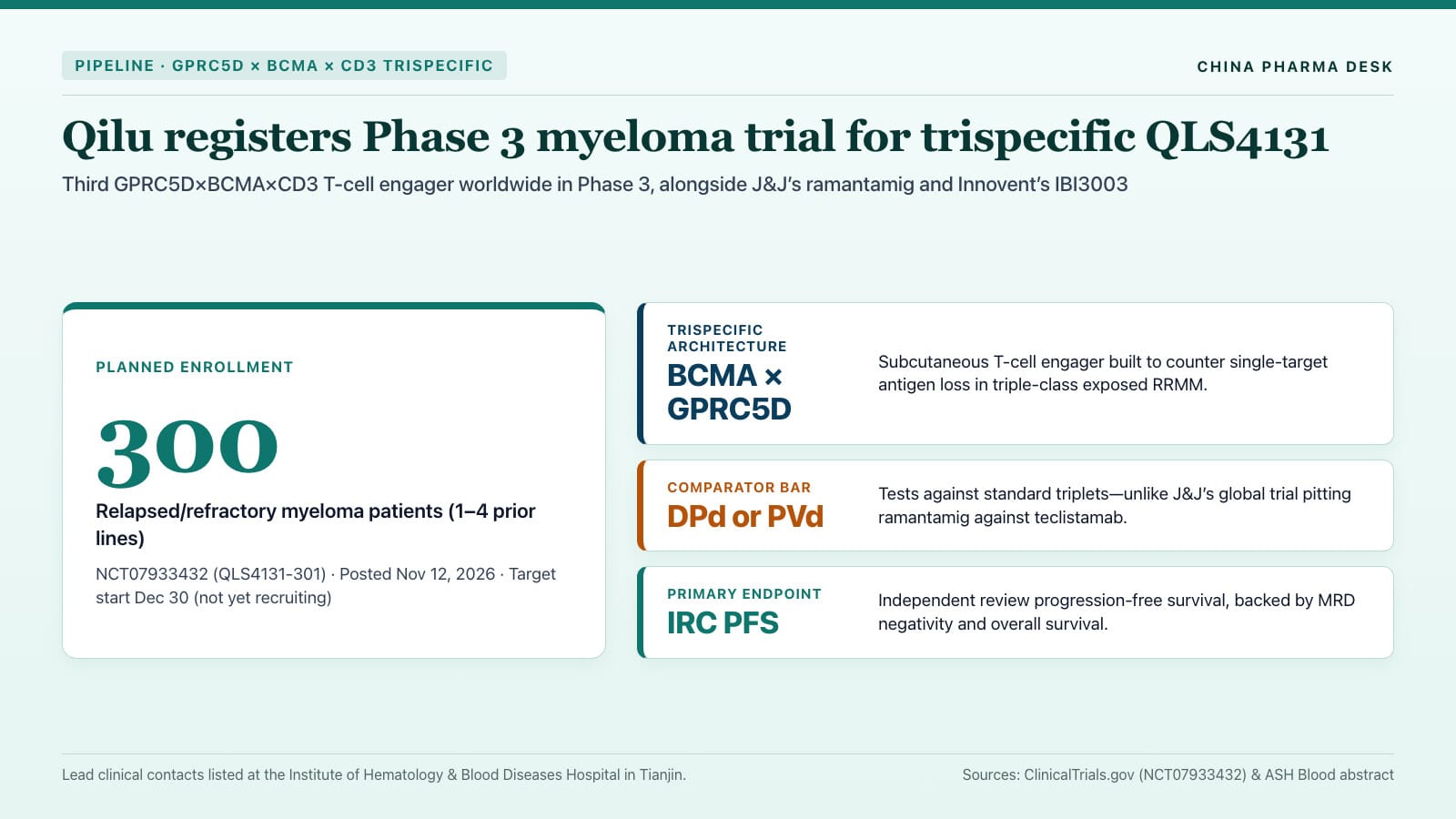
Qilu Pharmaceutical Co., Ltd. has posted a 300-patient, open-label Phase 3 trial on ClinicalTrials.gov (NCT07933432, study ID QLS4131-301) to test subcutaneous GPRC5D×BCMA×CD3 trispecific T-cell engager QLS4131 against investigator’s-choice triplet regimens in relapsed or refractory multiple myeloma (RRMM). First posted on November 12 with study contacts at the Institute of Hematology & Blood Diseases Hospital in Tianjin, the study makes QLS4131 the third GPRC5D×BCMA×CD3 trispecific antibody worldwide to reach a Phase 3 registration listing—though, like Qilu’s newly posted Claudin6 ADC trial earlier this week, recruitment has not yet started ahead of an estimated December 30, 2026 launch.
Reaching Phase 3 puts Qilu in a three-drug global lead pack. Its choice of control arm defines the commercial bar.
Simultaneously targeting BCMA and GPRC5D on myeloma cells is designed to prevent single-antigen escape—a key driver of relapse after BCMA CAR-T or bispecific therapy. According to Qilu’s first-in-human Phase 1a abstract in Blood (NCT06500507), QLS4131 incorporates a moderate-affinity GPRC5D nanobody domain intended to curb skin, nail, and oral toxicities while maintaining T-cell killing, logging no dose-limiting toxicities in early escalation. Investigator-initiated Phase 2 trials at Tianjin’s hematology institute are also testing QLS4131 in newly diagnosed light-chain amyloidosis (NCT07751471) and with isatuximab in primary plasma-cell leukemia (NCT07903623).
Global GPRC5D × BCMA × CD3 trispecific clinical race
| Candidate | Developer / Partner | Furthest MM Stage | Pivotal Comparator & Trial Design |
|---|---|---|---|
Ramantamig (JNJ-79635322) |
Johnson & Johnson | Global Phase 3 (NCT07258511, enrolling) |
Head-to-head vs. teclistamab (anti-BCMA×CD3 bispecific) |
| IBI3003 | Innovent Biologics (HKEX: 01801) |
China Phase 3 (n=255, initiated May 2026) | Randomized open-label vs. investigator’s choice DPd or PVd |
| QLS4131 | Qilu Pharmaceutical | Phase 3 posted (NCT07933432, n=300, not yet recruiting) |
Randomized open-label vs. investigator’s choice DPd or PVd |
| MBS314 | Beijing Mabworks Biotech | China Phase 1/2 (NCT07911748, n=78) |
Single-arm dose escalation and expansion in RRMM |
| SIM0500 | Simcere (HKEX: 02096) / AbbVie |
Global/China Phase 1 (NCT06375044, recruiting) |
First-in-human monotherapy escalation/expansion ($1.055B AbbVie option deal) |
Protocol boundaries that matter for global benchmarking
In QLS4131-301, eligible adults must have received one to four prior lines of therapy—including a proteasome inhibitor, an immunomodulatory drug, and an anti-CD38 monoclonal antibody (triple-class exposed). Notably, the protocol allows patients previously treated with either a BCMA-targeted or a GPRC5D-targeted agent alone, excluding only those exposed to both.
Participants randomized to the control arm will receive standard DPd (subcutaneous daratumumab, pomalidomide, and dexamethasone) or PVd (pomalidomide, bortezomib, and dexamethasone) until progression. The primary endpoint is progression-free survival (PFS) assessed by an independent review committee up to two years after the last patient’s first dose, backed by secondary minimal residual disease (MRD) negativity and overall survival readouts through an estimated December 2029 primary completion.
For overseas hematology and licensing desks, that comparator split is the critical fine print:
- Domestic registration speed vs. global differentiation: Beating DPd or PVd in 1–4 prior-line Chinese patients—where Innovent’s IBI3003 is running nearly the same playbook—offers a straightforward path to NMPA marketing approval. By contrast, Johnson & Johnson’s global Phase 3 (
NCT07258511, started February 2026) pits ramantamig directly against its own marketed BCMA bispecific teclistamab to prove that adding a third binding arm outperforms an established T-cell engager. - What ex-China partners will scrutinize: Because QLS4131’s Phase 3 will not generate head-to-head data against a bispecific antibody, any future ex-China licensing pitch will hinge on cross-trial benchmarks: sustained 12-month MRD negativity, response durability in the subset with prior BCMA exposure, and Grade ≥3 infection and GPRC5D-related dysgeusia or rash rates once full Phase 1/2 expansion datasets are published.
The immediate operational trigger is site list activation and first-patient dosing around Qilu’s target December 30 start date, alongside updated Phase 1/2 RRMM response durability at upcoming hematology meetings.
Related on China Pharma Desk: Qilu registers a 420-patient Phase 3 for Claudin6 ADC QLS5132 · A day after TYK’s RMB 300m settlement, Qilu returns to buy H-shares at half July’s price