Seven weeks after EC revocation, EMA's CHMP backs Hansoh's Aumseqa alongside Innovent's sintilimab
Hansoh Pharmaceutical (HKEX: 03692) disclosed on Nov 15, 2026 that EMA's CHMP backed Aumseqa (aumolertinib, EMEA/H/C/007167) on Nov 12 after a Sept revocation, alongside Innovent's (HKEX: 01801) Zybrivo.
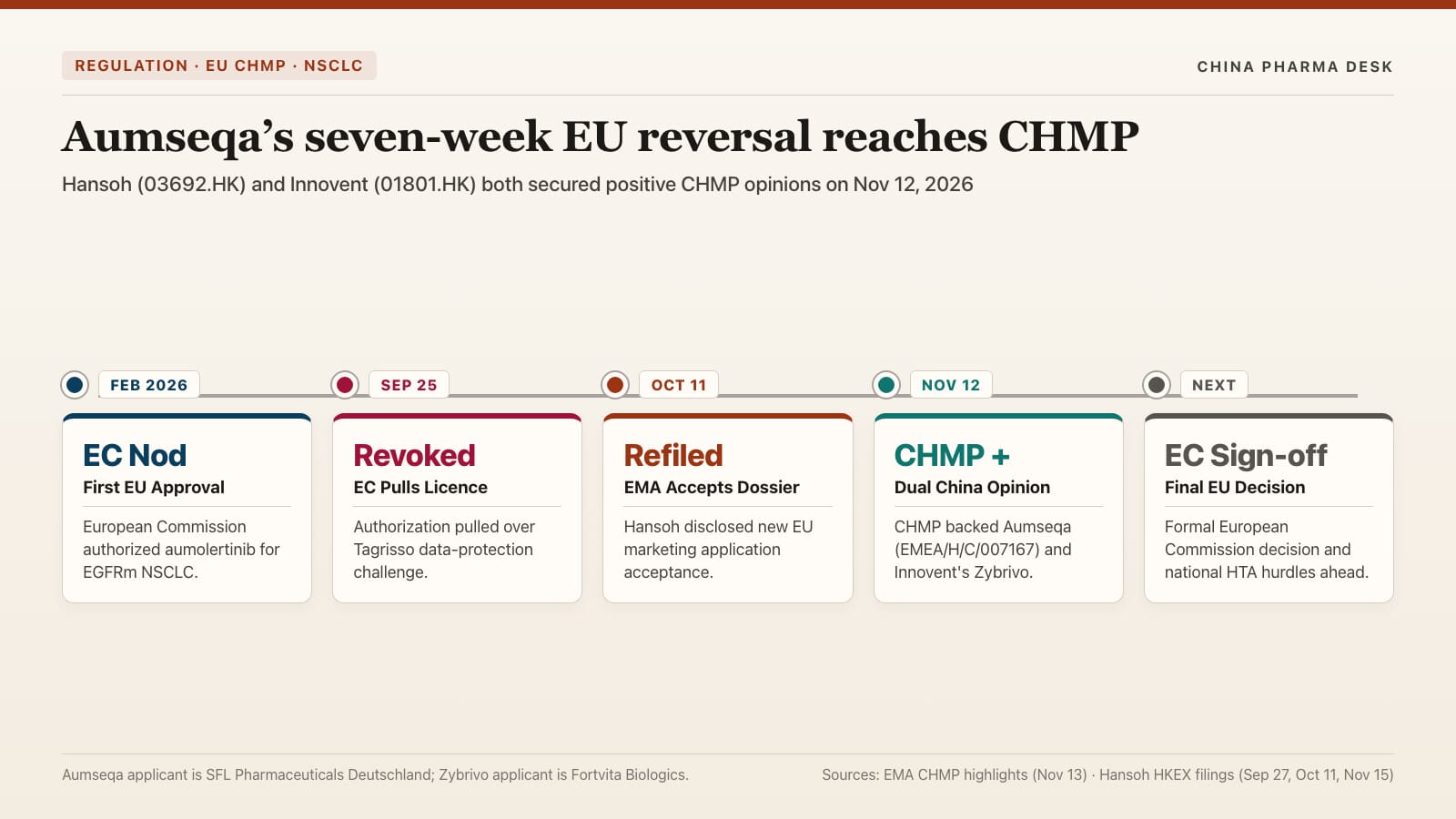
On November 15, 2026, Hansoh Pharmaceutical Group (HKEX: 03692) disclosed to the Hong Kong Stock Exchange that the European Medicines Agency’s (EMA) Committee for Medicinal Products for Human Use (CHMP) adopted a positive opinion on November 12 recommending EU marketing authorization for EGFR tyrosine kinase inhibitor aumolertinib (Aumseqa, procedure EMEA/H/C/007167) in non-small cell lung cancer (NSCLC)—just seven weeks after the European Commission revoked an earlier EU license over AstraZeneca’s Tagrisso data-protection challenge. At the same November 9–12 meeting, CHMP also recommended EU approval for Innovent Biologics’ (HKEX: 01801) PD-1 antibody sintilimab (Zybrivo, filed by Fortvita Biologics Ireland) in first-line non-squamous NSCLC, creating a stark contrast with the U.S. FDA’s November 15 Complete Response Letter against Akeso and Summit’s ivonescimab.
Neither positive opinion grants immediate commercial sales in Europe: both products await final European Commission (EC) sign-off—and must still clear national pricing and Joint Clinical Assessment (JCA) hurdles dominated by AstraZeneca’s Tagrisso and Merck’s Keytruda.
Aumseqa’s rapid EU regulatory turnaround
According to EMA’s published summary of opinion (EMA/CHMP/241855/2026), Aumseqa 55 mg tablets—submitted by German marketing applicant SFL Pharmaceuticals Deutschland GmbH—are recommended as monotherapy for adults with advanced NSCLC harboring EGFR exon 19 deletions or exon 21 L858R mutations (first-line, citing superior PFS over gefitinib) and for EGFR T790M resistance mutations (citing response rate and duration of response). Common side effects noted by EMA include elevated AST/ALT, hyponatremia, raised CPK, cytopenias, upper respiratory infections, and rash.
The seven-week turnaround is unusual in EU drug regulation. Hansoh originally secured CHMP backing in November 2025 and EC approval in February 2026, before disclosing on September 27 that the EC had revoked the authorization on September 25. As Fierce Pharma and Citeline Pink Sheet reported, the EC pulled the earlier approval after finding that the 2022 dossier improperly referenced regulatory data for AstraZeneca’s Tagrisso (osimertinib, which generated nearly $3.8 billion in H1 2026), following an EU General Court lawsuit by AstraZeneca. Hansoh disclosed on October 11 that EMA had accepted a resubmitted application, culminating in the November 12 CHMP recommendation. Notably, EMA’s new public overview page does not detail the relationship between the September revocation and EMEA/H/C/007167, leaving open whether any further legal challenge or pricing condition could arise during the EC decision phase.
Meanwhile in China, where aumolertinib (Ameile) holds five approved indications and underpins Hansoh’s commercial oncology franchise alongside its newly signed RMB 317 million AI cyclic-peptide deal with AilsynBio, Hansoh separately reported on November 15 that aumolertinib plus pemetrexed and platinum chemotherapy (approved January 2026) won 2026 NRDL inclusion.
Zybrivo finds an EU path four years after FDA rejection
In the EMA November 2026 CHMP highlights, Fortvita Biologics (Ireland) Limited—an overseas subsidiary of Innovent Biologics—received a positive opinion for Zybrivo (sintilimab 100 mg concentrate) combined with pemetrexed and platinum chemotherapy as first-line treatment for adults with EGFR/ALK-wild-type non-squamous NSCLC regardless of PD-L1 expression.
The European recommendation revives an asset whose U.S. path closed in 2022, when the FDA rejected an Eli Lilly-backed BLA built on China-only ORIENT-11 data against a chemotherapy comparator rather than an immunotherapy standard, prompting Lilly to return ex-China rights to Innovent. Even with EC approval ahead, Zybrivo faces stiff commercial constraints in Europe: Citeline noted that sintilimab struggled in the EU’s Joint Clinical Assessment against pembrolizumab-anchored standards of care, meaning national payer reimbursement in Germany, France, and the U.K. will depend heavily on price discounting.
Next evidence triggers
- European Commission final decisions for
Aumseqa(EMEA/H/C/007167) andZybrivo, typically issued roughly 67 days after a CHMP positive opinion (around January 2027), alongside publication of full European Public Assessment Reports (EPARs). - Any follow-on EU General Court filings or data-exclusivity objections regarding
Aumseqa’s resubmitted dossier once the EC decision enters the Union Register. - National HTA and reimbursement filings in major EU markets for
ZybrivoandAumseqa—and whetherAumseqajoins its 2025 U.K. MHRA approval with continental EU commercial launches in 2027.