Evopoint wins first China drug approval for ICU pneumonia antibiotic funobactam two months after STAR Market IPO
Suzhou Evopoint Biosciences (688837.SS) won China NMPA approval for Class 1 antibiotic imipenem-cilastatin-funobactam (Funuokai, XNW4107) in adult HABP/VABP after Phase 3 REITAB-2 (NCT05204563).
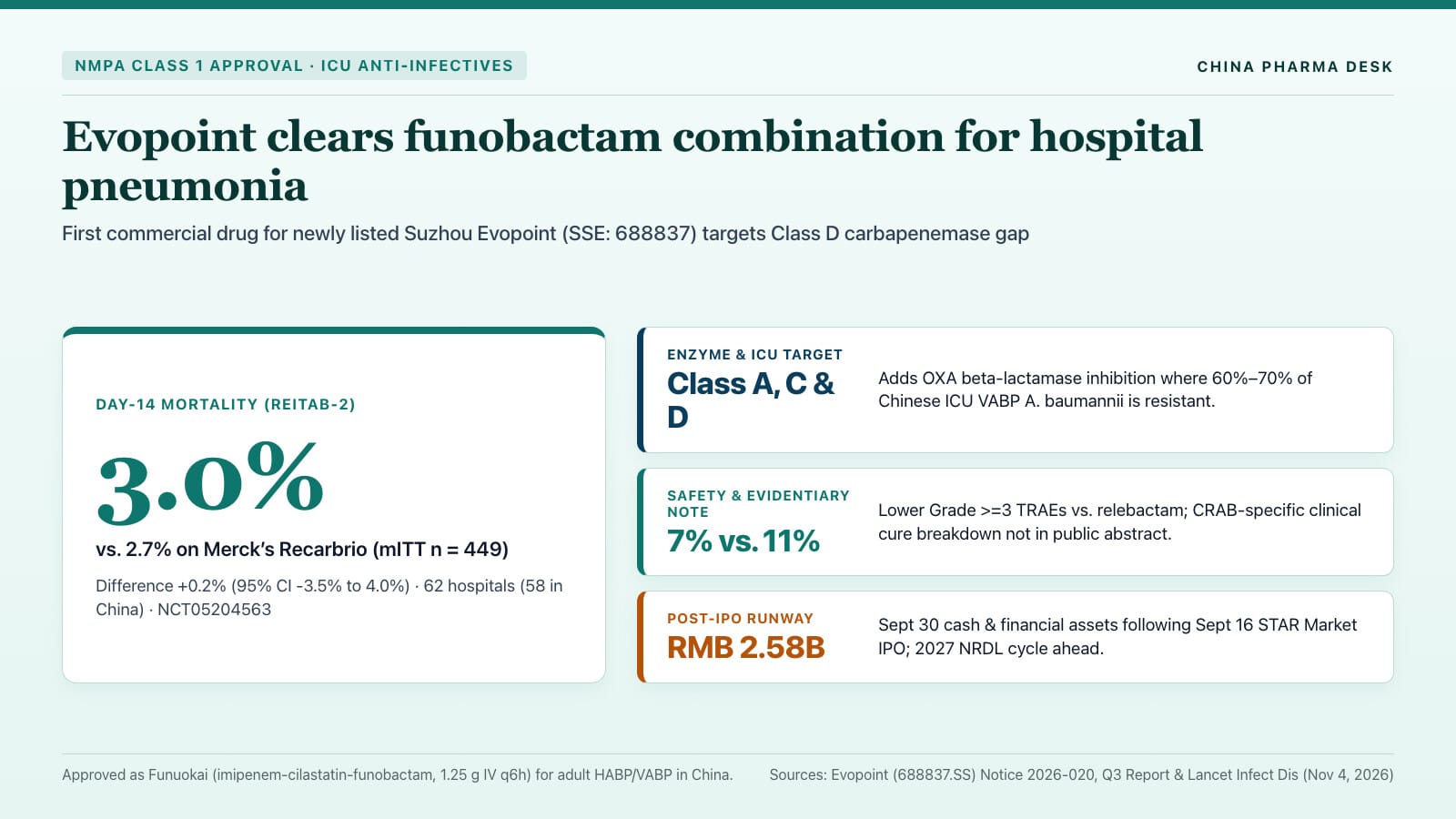
Suzhou Evopoint Biosciences (SSE: 688837) won Chinese marketing approval from the National Medical Products Administration (NMPA) for Class 1 injectable antibiotic imipenem-cilastatin-funobactam (Funuokai), clearing the company’s first commercial product two months after its September 16, 2026 Shanghai STAR Market debut. Disclosed in SSE Notice No. 2026-020 (dated November 13, 2026), the combination pairs imipenem/cilastatin with Evopoint’s diazabicyclooctane beta-lactamase inhibitor funobactam (XNW4107) for adults with hospital-acquired or ventilator-associated bacterial pneumonia (HABP/VABP), backed by the 450-patient multinational Phase 3 REITAB-2 trial (NCT05204563). While funobactam’s in-vitro inhibition of Class D carbapenemases targets China’s severe intensive-care Acinetobacter burden, pathogen-stratified clinical cure breakdowns remain a key focal point beyond the headline mortality readout.
Pivotal REITAB-2 data: matching Recarbrio on 14-day mortality
Cleared roughly 16 months after CDE accepted the NDA in July 2025—in the same November 12 NMPA innovation batch that approved Jiangsu Hengrui’s ANGPTL3 antibody SHR-1918 and Eli Lilly’s oral GLP-1 orforglipron (Muyouda)—Funuokai relies on REITAB-2, led by Professor Bin Cao at China-Japan Friendship Hospital and published online on November 4, 2026 in The Lancet Infectious Diseases.
Across 62 hospitals (58 in China, three in the United States, and one in Spain), 450 hospitalized adults with Gram-negative HABP or VABP were randomized 2:1 to receive 1.25 g intravenous infusions every six hours for 7 to 14 days of either imipenem-cilastatin-funobactam or Merck & Co.’s imipenem-cilastatin-relebactam (Recarbrio):
REITAB-2 Metric (NCT05204563, mITT n = 449) |
Imipenem-Cilastatin-Funobactam (n = 299) | Imipenem-Cilastatin-Relebactam (n = 150) | Difference / Threshold |
|---|---|---|---|
| Day-14 all-cause mortality (primary) | 3.0% (9 / 299) | 2.7% (4 / 150) | +0.2% (95% CI -3.5% to 4.0%; 10% NI margin) |
| Grade ≥3 treatment-related adverse events | 7% (22 / 299) | 11% (16 / 150) | Zero drug-related deaths in either arm |
| Enzyme inhibition spectrum | Class A, C, and Class D (OXA) | Class A and C (lacks Class D activity) | Targets CRAB, CRE, and CRPA |
The China ICU delta—and the pathogen-level caveat
The commercial logic behind XNW4107 in China differs sharply from Western hospital markets because of pathogen mix inside Chinese intensive care units. Citing national respiratory guidelines and 2024 CHINET surveillance in its SSE filing, Evopoint noted that Acinetobacter baumannii accounts for 35.7% to 50.0% of VABP cases in large Chinese general hospitals, with carbapenem-resistant A. baumannii (CRAB) reaching 60% to 70%—alongside 20% to 40% carbapenem-resistant Pseudomonas aeruginosa (CRPA) and 22% to 25% carbapenem-resistant Klebsiella pneumoniae (CRKP).
Merck’s relebactam restores imipenem activity against KPC-producing Enterobacterales (Class A) and Class C beta-lactamases, but leaves OXA-producing CRAB (Class D) uncovered. Funobactam’s spiro-cyclopropyl diazabicyclooctane scaffold was engineered to inhibit Class A, C, and D enzymes simultaneously, winning U.S. FDA QIDP and Fast Track tags and entering a separate 780-patient global Phase 3 complicated urinary tract infection trial (NCT05204368).
Hospital pharmacy and therapeutics (P&T) committees will nonetheless weigh an important evidentiary boundary flagged in an accompanying Lancet Infectious Diseases commentary by Mathias Pletz and colleagues at Jena University Hospital: while REITAB-2 established overall 14-day mortality non-inferiority with unusually low event rates in both arms (3.0% vs. 2.7%), the public study abstract does not break out clinical cure or mortality specifically within confirmed CRAB subgroups. In Chinese tertiary hospitals, Funuokai will also compete for restricted special-grade antibiotic budgets against Innoviva/Zai Lab’s sulbactam-durlobactam (Xacduro, approved by NMPA in May 2024 specifically for Acinetobacter) and domestic polymyxin/tigecycline regimens.
Post-IPO balance sheet and next commercial gates
Backed by fresh IPO proceeds, Evopoint enters commercialization with substantial liquidity. Per its Q3 2026 report (SSE: 688837, filed October 29, 2026), the company held RMB 2,247.5 million (approx. $312.2 million) in cash and cash equivalents plus RMB 331.9 million (approx. $46.1 million) in trading financial assets as of September 30, 2026—a combined RMB 2.58 billion reserve against nine-month R&D spending of RMB 463.7 million and a nine-month net loss of RMB 295.9 million.
Because the approval landed four months after China’s 2026 NRDL formal review cutoff, Funuokai’s immediate commercial test lies in provincial procurement-platform price postings, tertiary-hospital formulary entry under China’s Class 1 hospital access rules, and whether Evopoint files for national reimbursement in the 2027 NRDL cycle.