China’s next drug-price reset runs on provincial clocks
Fujian’s new notice and Beijing’s rollout show separate price, procurement and payment switches. The 70% payment-standard rule also needs a floor—not a reimbursement shortcut.
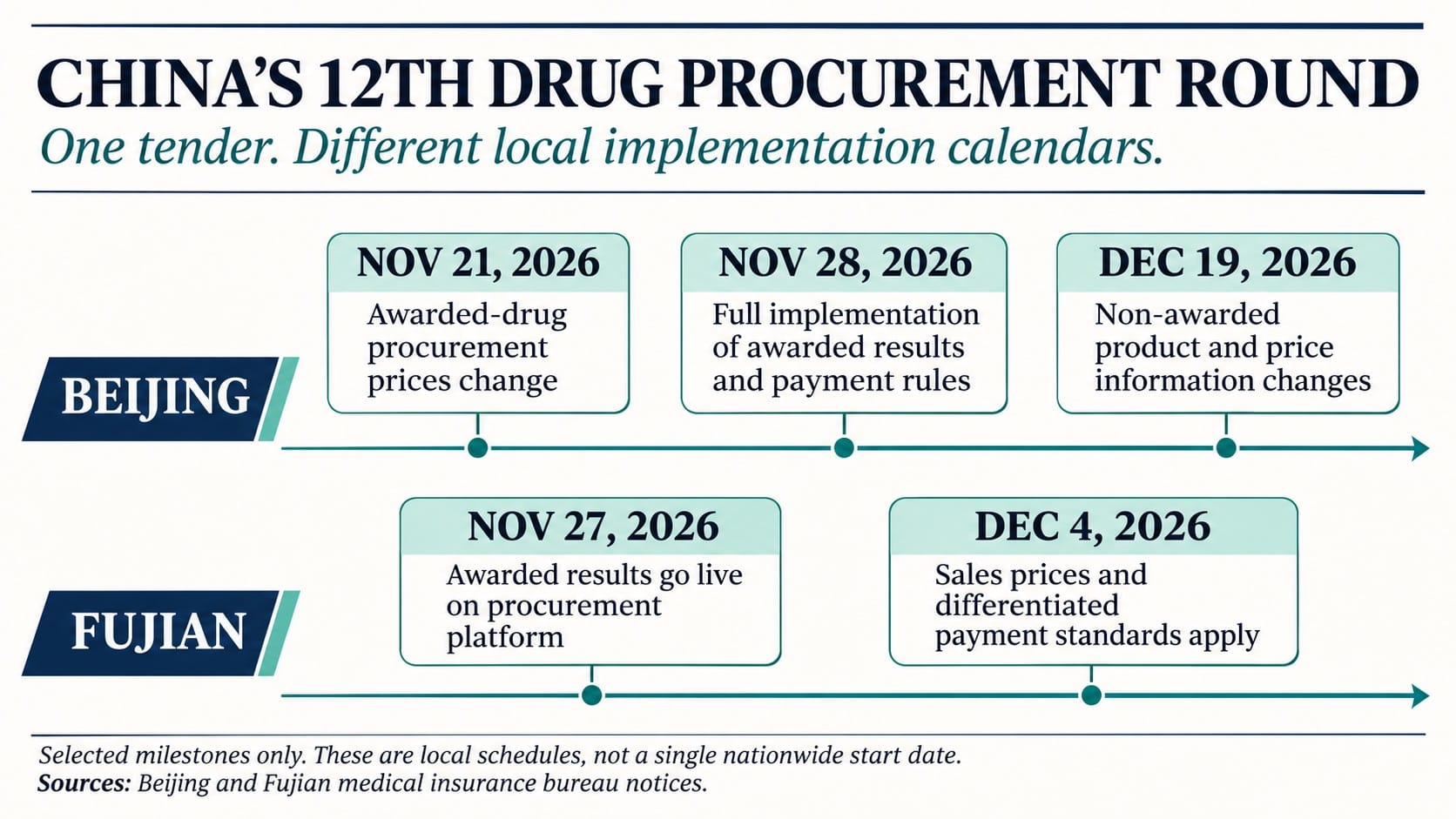
Fujian’s newly published implementation notice for China’s 12th national drug-procurement round illustrates why an awarded price is only the beginning of a market-access change. Platform activation, hospital purchasing and insurance payment can move on separate dates—and the calendar differs by location.
For manufacturers planning supply or tracking the exposure of non-awarded products, a single “national rollout date” would hide commercially important steps.
China’s volume-based procurement, or VBP, links awarded prices to purchasing commitments. The national selection still needs local execution: products and prices enter procurement systems, institutions arrange supply, and payment rules change. A tender result alone does not establish when every hospital will dispense a product.
The calendar has more than one switch
Fujian’s notice posted November 12 and signed November 10 covers 65 selected drug categories. It separates procurement-platform activation from the application of sales prices and differentiated insurance-payment standards. Beijing’s notice posted November 3 divides its implementation into additional stages.
| Location | Selected implementation milestones |
|---|---|
| Fujian | November 27: awarded results go live on the procurement platform. December 4: specified sales prices and differentiated payment standards apply. |
| Beijing | November 21: awarded-drug procurement prices change and preparation begins. November 28: full implementation of awarded results and payment policies. December 19: non-awarded product and price information changes. |
These are selected milestones from two jurisdictions, not a complete national schedule. Nor should a preparation window be presented as evidence that every hospital already has stock.
For a supplier, that distinction separates a system deadline from a distribution deadline. For an analyst, it means that shipment, purchase-price and payment changes may not line up neatly within the same reporting period. Any estimate of the sales impact still needs product-level exposure and actual purchasing data.
Fujian’s 70% figure is a payment benchmark, not a reimbursement promise
Fujian also spells out a rule for certain non-awarded products in its “non-competitive group.” When the sales price exceeds the lowest awarded price, the payment standard is 70% of the sales price, with that lowest awarded price as a floor. When the sales price is no higher than that benchmark, the standard equals the sales price. Other product groupings have different provisions.
A simplified calculation shows why the floor matters. If the sales price were RMB 100 and the lowest awarded price RMB 60, the standard would be RMB 70. At a sales price of RMB 80 with the same benchmark, it would be RMB 60, because 70% of RMB 80 is only RMB 56. These are illustrative inputs, not quoted drug prices.
The standard is not itself the amount the insurer pays, and “70%” is not a universal patient reimbursement rate. Actual settlement depends on the applicable benefit rules. Treating the number as a guaranteed payout would confuse a payment base with insurance benefits.
Winning does not end the execution risk
Beijing requires timely hospital access for awarded medicines carrying agreed purchasing tasks, without a committee vote, while retaining clinical-use and supply safeguards. Fujian requires awarded suppliers to keep supplying at awarded prices even beyond agreed annual volumes through the procurement period.
Together, these provisions show the two sides of a purchasing commitment: easier administrative entry can come with continuing supply obligations. Neither proves future revenue, complete substitution of competing products or smooth delivery.
The useful watchpoints are therefore specific: the local price and payment switches, hospitals’ actual purchasing, and suppliers’ ability to meet demand. A national award establishes an opportunity and obligations; the provincial instructions explain how those begin to operate.
AI-assisted reporting and analysis based on the linked notices. Industry information only—not medical or investment advice.