Zai's ZL-1503 supports a long-dose-interval hypothesis. Patient data come next.
Zai Lab (NASDAQ: ZLAB; HKEX: 09688) reported ZL-1503 Phase 1 healthy-volunteer data on November 13. Trial NCT07235384 moves the IL-13/IL-31R alpha bispecific toward patient readouts.
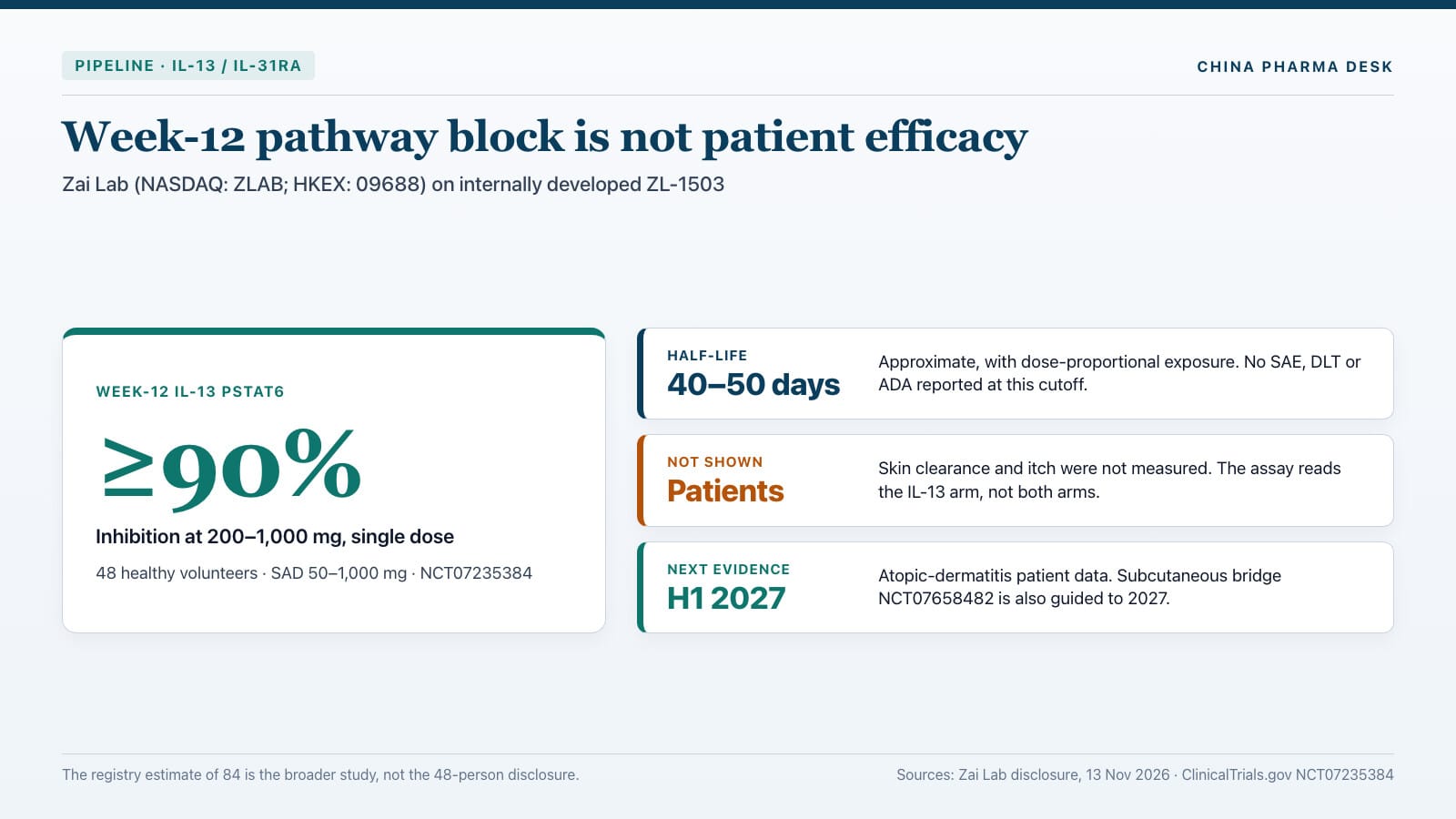
Zai Lab Limited (NASDAQ: ZLAB; HKEX: 09688) reported preliminary first-in-human results for its internally discovered IL-13/IL-31 receptor alpha bispecific antibody ZL-1503 on November 13. Its company disclosure describes sustained IL-13 pathway inhibition in the healthy-volunteer portion of Phase 1/1b trial NCT07235384. The findings support further testing of extended dosing, with atopic-dermatitis patient results expected in the first half of 2027.
The reported population comprises 48 healthy volunteers receiving single ascending doses from 50 to 1,000 mg or placebo. At doses of 200 to 1,000 mg, inhibition of IL-13-stimulated phosphorylated STAT6 was at least 90% at week 12. The reported serum half-life was approximately 40–50 days, with dose-proportional exposure.
At the data cut-off, Zai reported no serious adverse events, dose-limiting toxicities or detected anti-drug antibodies; most treatment-emergent adverse events were mild. These observations come from the single-dose healthy-volunteer cohort.
An internal pipeline plan becomes a measurable clinical programme
The result also advances a strategy that predates this readout. In a January 15, 2025 profile, E-Yao Manager described Zai’s effort to combine licensed products with internally developed candidates, including planned global Phase 1 entry for ZL-1503. That was a development plan, not patient evidence.
The subsequent disclosures provide a more precise sequence:
- December 8, 2025: Zai announced that the first participant had been dosed in the global Phase 1/1b programme. The announcement explicitly identified ZL-1503 as an internally discovered and developed candidate.
- May 7, 2026: The company’s first-quarter update said the study was ongoing and targeted first-in-human data in the second half of 2026.
- November 13, 2026: The healthy-volunteer disclosure delivers an initial human readout within that window, while the atopic-dermatitis patient cohort remains the next test.
This gives the company evidence of execution on an internal immunology programme. For the asset, the next increase in confidence must come from connecting exposure and pathway inhibition to durable skin and itch outcomes at a practical dose and route. That is the step that could turn a completed early milestone into a differentiated development proposition.
What the 12-week result actually establishes
The distinction between exposure and disease control is central to the asset’s competitive proposition. Long persistence plus a measurable pharmacodynamic effect gives Zai a basis for studying less frequent administration. It does not yet tell developers which dose interval will preserve skin clearance and itch control in patients.
The reported pSTAT6 assay measures the IL-13 pathway, so the 12-week finding establishes activity on that arm of the molecule. The value of combining inflammation and itch pathways will depend on patient outcomes at the intended exposure; the assay alone does not establish equivalent persistence of both arms.
The NCT07235384 registry record separates the single-ascending-dose healthy-volunteer component from multiple ascending doses in adults with moderate-to-severe atopic dermatitis. Its estimated enrolment of 84 covers the broader study; it is not the number included in the 48-person disclosure. That separation will matter when interpreting subsequent efficacy and safety results.
A clinical benchmark already exists for longer maintenance intervals
Galderma’s IL-31 receptor antagonist nemolizumab-ilto (Nemluvio) provides a relevant, qualified benchmark. Its U.S. prescribing information, updated June 2025, permits 30 mg subcutaneously every eight weeks after 16 weeks of treatment for atopic-dermatitis patients who achieve clear or almost clear skin. The indication includes concomitant topical corticosteroids and/or calcineurin inhibitors and specified eligibility conditions.
The comparison concerns an established maintenance option, not relative efficacy between trials. For ZL-1503, a future 12-week maintenance schedule would need to demonstrate durable patient benefit through the full interval, with an acceptable safety profile. A long half-life alone would not establish an advantage over a response-qualified eight-week regimen.
Route of administration is the other practical test. Zai says enrolment is complete in its intravenous-to-subcutaneous bioavailability study, with initial data expected in 2027. The separately registered NCT07658482 is an open-label Phase 1 comparison of subcutaneous and intravenous administration, with pharmacokinetic and bioavailability assessments.
The two 2027 readouts answer complementary questions: patient data test whether the proposed interval controls disease, and the bridging study tests whether subcutaneous exposure can support the intended delivery route. Together they will provide a firmer basis for judging ZL-1503’s differentiation than the healthy-volunteer biomarker result alone.
Updated November 14, 2026: Added historical company context and a source-checked clinical-development timeline.