Cebranopadol's U.S. NDA advances Conba's licensed asset, within defined China rights
Zhejiang CONBA Pharmaceutical (SSE: 600572) disclosed Adneuris' U.S. NDA submission for cebranopadol on November 14; its July licence covers acute pain in Greater China.
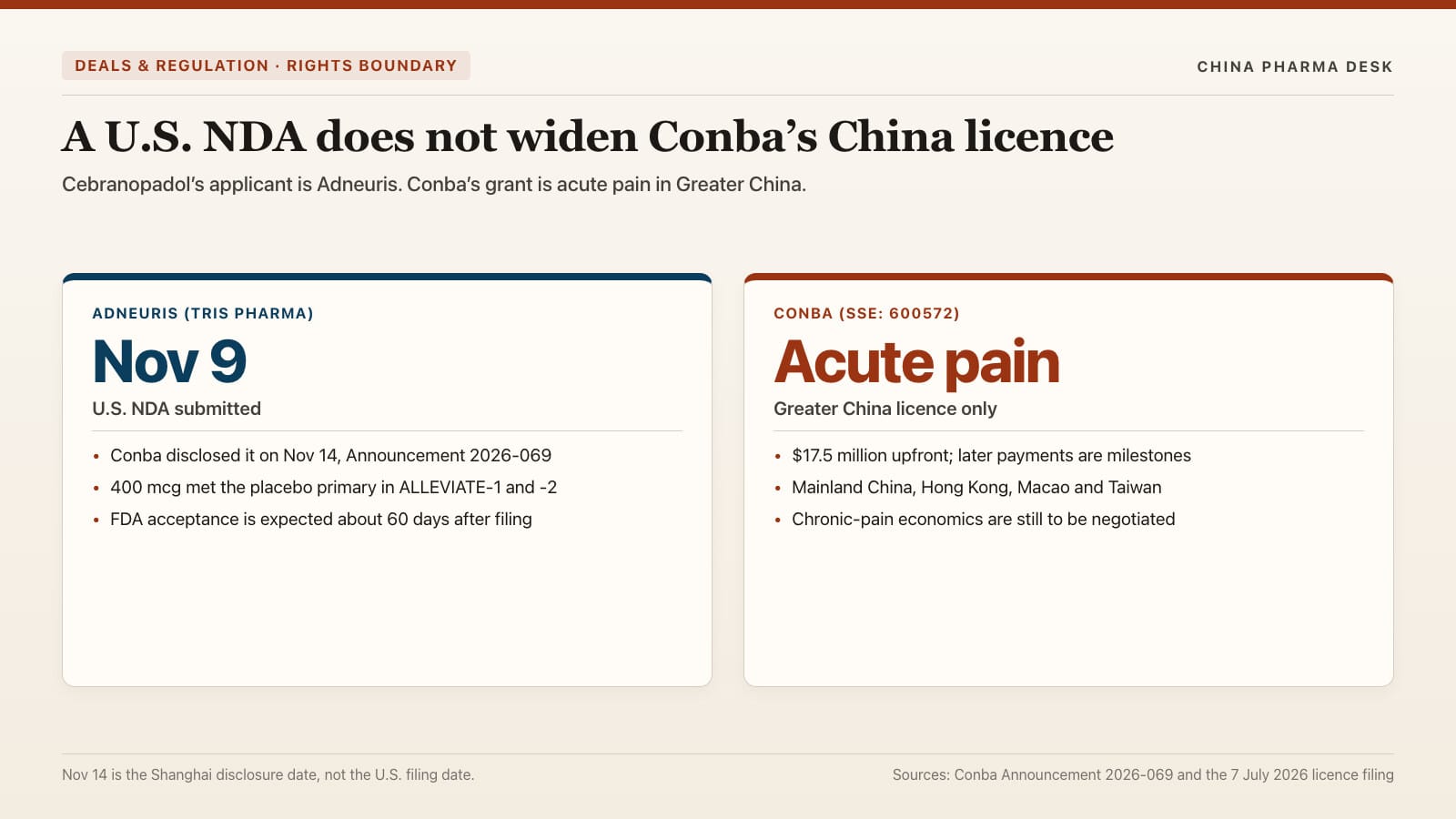
Zhejiang CONBA Pharmaceutical (SSE: 600572) disclosed on November 14 that Adneuris Therapeutics had submitted a U.S. new drug application for cebranopadol, the NOP/MOP receptor agonist licensed to Conba for acute pain in Greater China. Conba Announcement 2026-069 is a domestic follow-up to the November 9 submission announcement from Adneuris’ parent, New Jersey-based Tris Pharma. Adneuris is the U.S. applicant; Conba holds the specified regional rights.
The distinction matters for both timing and asset ownership. The filing is progress for a licensed-in medicine in Conba’s portfolio. It is not a new global acquisition by Conba, and the U.S. submission should not be dated November 14 simply because that is the date of the Shanghai-listed company’s announcement.
What Conba bought in July
The July 7 stock-exchange disclosure of the July 3 agreement identifies Conba’s subsidiaries as licensees and Adneuris, a wholly owned Tris subsidiary, as licensor. Initial exclusive rights cover development, manufacture and commercialisation for acute pain in mainland China, Hong Kong, Macao and Taiwan.
The agreed upfront payment was $17.5 million. Further development and commercial payments are contingent on milestones, including approvals and regional sales. A U.S. submission advances the asset’s regulatory path but should not be treated as evidence that a particular undisclosed payment has now been triggered.
The agreement also contemplates expansion into chronic-pain indications. Additional development milestones for those indications are to be negotiated separately. Cancer pain, chronic low back pain and other potential uses should therefore not be valued as unconditional, fully secured extensions of the initial acute-pain licence.
The clinical package and the relevant limit on comparison
Adneuris says the submission draws on the placebo-controlled Phase 3 ALLEVIATE-1 study after abdominoplasty (NCT06545097) and ALLEVIATE-2 after bunionectomy (NCT06423703). The company reports that the 400-microgram dose met the primary endpoint against placebo in both studies. Reported adverse events occurring in at least 10% included nausea, vomiting and dizziness; the company reported no drug-related serious adverse events.
Cebranopadol’s MOP activity also makes the phrase “non-opioid pain drug” inappropriate. Adneuris argues that combined NOP/MOP activity offers a differentiated profile, but that claim should remain separate from regulatory conclusions about labelling or abuse potential.
The U.S. competitive setting already includes Vertex Pharmaceuticals’ suzetrigine (Journavx), a sodium-channel blocker approved by the FDA on January 30, 2025 for moderate-to-severe acute pain in adults. Its pivotal programme also used abdominoplasty and bunionectomy models. Shared surgical models do not make these programmes a head-to-head comparison, and placebo-controlled success alone cannot establish which treatment has the better overall profile.
The China value depends on the next regulatory decisions
The U.S. dossier creates a more advanced reference package for Conba’s regional development planning. Its eventual usefulness depends on the review outcome, resulting label and the evidence required for local registration. The commercial opportunity is tied to delivering an approved regional product under the licensed indication.
Adneuris expects an FDA filing-acceptance response approximately 60 days after submission, followed, if accepted, by a review designation and target decision date. That acceptance decision is the next specific U.S. checkpoint. For Conba, a disclosed China development or registration step will provide the next direct evidence that the regional licence is moving toward its own market.